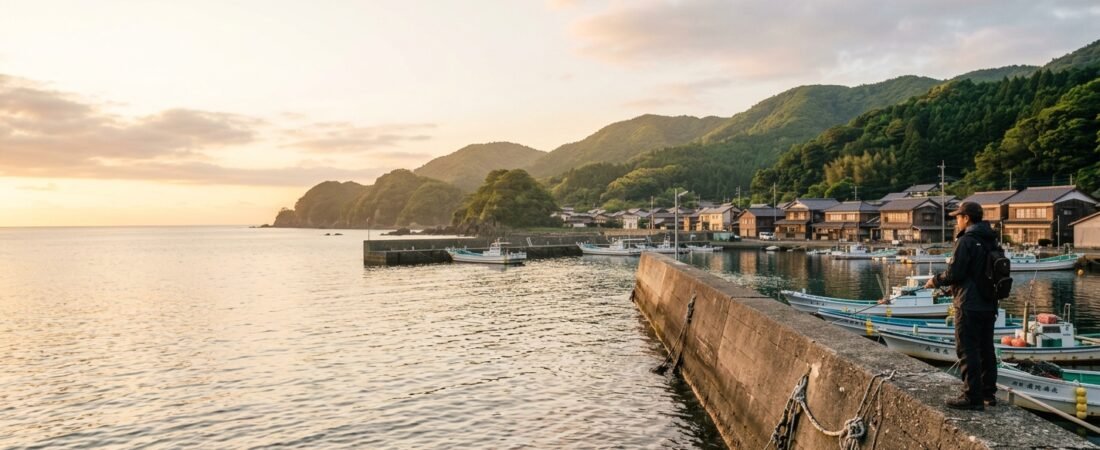
Information checked: This guide is based on official information from Japan’s Fisheries Agency and prefectural governments, checked on September 26, 2026. The local octopus rules for the Akashi coast were checked on October 1, 2026. Laws and local rules can change, and they vary by prefecture, fishing cooperative and fishing spot. Before you go fishing, check the latest information through the official links at the end of this guide.
Planning a fishing trip to Japan? One of the first things most anglers want to know is whether they need a fishing license in Japan. The answers online don’t agree. The official guide from the Japan National Tourism Organization (JNTO) says visitors will generally need some sort of permit or license, even for a single day. Other fishing guides say Japan has no fishing license at all and that saltwater fishing is free.
So which is right? It depends on where you fish, what you catch, and how you catch it. For this guide, I checked the official pages of Japan’s Fisheries Agency and prefectural governments. Below, I explain what you actually need for sea fishing, rivers and lakes, and fishing charters.
Quick Answer: Do You Need a Fishing License in Japan?
- No national fishing license: Based on the official information I checked, Japan has no nationwide recreational fishing license. Instead, laws and prefectural rules control the gear you can use, where and when you can fish, fish size limits, and even the use of lights at night.
- Rivers and lakes: In areas managed by a local fishing cooperative, you need to buy a fishing ticket (yugyoken).
- Sea fishing: Rod fishing and handline fishing are permitted for foreign visitors. However, taking shellfish, lobster, octopus and similar animals is illegal in many coastal areas. Abalone and sea cucumber are off-limits to almost everyone.
- Extra rules for foreign nationals: There are limits on gear and boat size. Japan’s Fisheries Agency asks foreign visitors to use registered fishing charters in principle.
- Rules vary by location: The Fisheries Agency advises checking with the prefecture or your fishing charter operator before you go.
Why Do Sources Disagree About Fishing Licenses in Japan?
Part of the confusion comes from the word “license.” A river fishing ticket is not a government license. It is a permit from a local fishing cooperative that lets non-members fish in its waters. One English fishing guide explains that a “license” (public permission) and a “ticket” (a cooperative’s fishing permit) are different things. Yet the English app-store listing for FISHPASS, an app that sells these tickets, calls them “Fishing Licenses.” Because the same thing is called a license, a permit, or a ticket, the information looks contradictory.
Fishing in Japan at a Glance: What You Need by Location
| Where you fish | What you need | Main things to check |
|---|---|---|
| Sea (shore, breakwaters) | No license or ticket system found in official sources | Protected species, allowed gear, no-entry areas |
| Sea (charter or tour) | Your tour fee | Advance notification if targeting bluefin tuna |
| Rivers and lakes (managed by a cooperative) | Fishing ticket (yugyoken) | Closed seasons, size limits, section rules |
| Paid fishing facilities | Facility fee | The facility’s own rules |
Freshwater Fishing in Japan: You Usually Need a Fishing Ticket
Many rivers and lakes in Japan are managed by local fishing cooperatives that hold a “Type 5 common fishing right.” These cooperatives must restock fish such as ayu (sweetfish) and carp, so they release young fish every year. If you are not a member, you must follow the cooperative’s fishing rules, which are approved by the prefectural governor. These rules set the fishing fee, the fishing ticket, and the fishing season.
How to Buy a Fishing Ticket (Yugyoken)
- You can buy tickets at the cooperative’s office, local tackle shops and some convenience stores. Prices vary from river to river.
- You can also buy them on your phone. The FISHPASS app says it covers more than 400 rivers across Japan. Tsuri Chike (つりチケ) lets you buy a ticket online and print it out. Both only cover their partner cooperatives.
- Cooperative areas are finely divided. Even on the same river, the upstream and downstream sections are often managed by different cooperatives. Check which cooperative manages the section you plan to fish.
Watch Out for Closed Seasons (Especially in Autumn)
- Example: In Yamanashi Prefecture, the season for yamame, amago and char (iwana) runs until September 30, and fishing for them is closed from October 1. During the closed season, simply casting a line counts as a violation, even if you catch nothing.
- Closed seasons vary by prefecture and cooperative.
Special Rules: Salmon, Lake Biwa and Black Bass
- Salmon: Catching salmon in rivers and lakes is banned, except in special cases.
- Lakes treated as “sea”: Some lakes, including Lake Biwa, Kasumigaura and Lake Hamana, are treated as sea areas under Japan’s Fisheries Act, so the rules for rivers and lakes don’t apply. For example, Ibaraki Prefecture says you need a fishing ticket for rivers and lakes other than Kasumigaura and Kitaura.
- Black bass fishing: Under Japan’s Invasive Alien Species Act, you cannot release black bass or bluegill into other waters, keep them, or transport them alive (catch-and-release on the spot is not prohibited by this law). Individuals who break this law face up to 3 years in prison or a fine of up to ¥3 million. In Shiga Prefecture, home of Lake Biwa, a prefectural ordinance also bans releasing bluegill and bass you catch. Collection boxes for these fish are set up at lakeside parks.
Sea Fishing in Japan: Know What You Can’t Catch
I could not find any license or ticket system for rod fishing in the sea in official sources. That doesn’t mean you can catch anything you like, though.
1. Shellfish, Seaweed, Lobster and Octopus in Fishing-Right Areas
Much of Japan’s coastline is covered by fishing rights held by local cooperatives. Fishing itself isn’t automatically banned in these areas. However, if you are not a cooperative member, taking shellfish such as abalone and turban shells (sazae), seaweed such as wakame and kombu, or bottom-dwelling animals like lobster and octopus may violate a fishing right. This can lead to a fine of up to ¥1 million. The protected species differ by area, so check before tide-pooling or clam digging.
Local Exception: Octopus Fishing on the Akashi Coast (Hyogo)
Along the coast of Akashi City, facing the Akashi Strait, anglers normally can’t fish for octopus inside the fishing-right area either. However, the Akashi City Federation of Fisheries Cooperatives allows octopus fishing for anglers who follow its local rules. The rules below apply from December 1, 2026:
- Season and hours: December 1 to March 31, from 5:00 a.m. to noon
- Size limit: No octopus weighing 100 g or less
- Catch limit: Up to 10 octopus per person
- Gear: Up to 2 octopus lures (tako-egi) per person, with barbless hooks bent no more than 180 degrees
- Juvenile nursery zone: Taking any fish or sea life there is banned, even for fishermen
- Where these rules apply: The first-class common fishing-right area off Akashi City shown on the official map. They also apply to people fishing from charter boats.
Fishing for octopus outside these rules can count as poaching (a fishing-right violation), and the flyer notes a fine of up to ¥1 million under Article 195 of the Fisheries Act.
Source: Akashi City Coast Octopus Fishing Rules and Manners (2026, Japanese PDF), published by the Akashi City Federation of Fisheries Cooperatives and listed on Hyogo Prefecture’s local fishing rules page. These rules are revised often. The 2025 version, for example, allowed fishing until April 30 with no time limit. Check the latest version before you go.
2. Abalone and Sea Cucumber Are Off-Limits
Abalone, sea cucumber and glass eels are designated as “specified aquatic animals.” Taking them without a permit or fishing right can lead to up to 3 years in prison or a fine of up to ¥30 million. It is still illegal even if a local cooperative tells you it’s okay to take “just a few.” Taking them in an area with no fishing rights is also illegal.
3. Only Certain Gear Is Allowed (Spearfishing Included)
The gear you can use for recreational fishing is set by each prefecture. Diving equipment (including simple breathing devices) and spearguns are not on the list, so you cannot use them. Even gear on the list may be banned in some prefectures. For example, Chiba Prefecture does not allow recreational anglers to use hand spears. Some permitted methods are also limited by area, size or number, especially chumming and fishing with lights.
4. Size Limits, Closed Seasons and No-Fishing Zones
Gear, no-fishing zones, closed seasons for each species and minimum sizes are set prefecture by prefecture. Breaking these rules can lead to penalties.
5. No-Entry Areas and Fishing Manners
The Fisheries Agency asks anglers to stay away from set nets and other fishing equipment, keep out of restricted areas at fishing ports, and take their trash home.
Special Fishing Rules for Foreign Visitors to Japan
Under the Act on the Regulation of Fishing Operations by Foreign Nationals and related laws, foreign nationals may only fish on a “minor scale.” The allowed gear depends on the size of the boat. Here is a summary for Japan’s territorial and internal waters (which include rivers, lakes and some bays):
| Method | From shore | Boat under 3 tons | Boat 3 tons or more |
|---|---|---|---|
| Rod fishing, handline fishing | ✅ | ✅ | Only on a Japanese charter or fishing boat under the control of a Japanese fisher |
| Landing net, scoop net, hand spear, clam rake | ✅ | ✅ | Same as above |
| Cast net | ✅ | ❌ | ❌ |
| Trolling | – | Only in designated areas and periods | Same as left, and only on a Japanese charter or fishing boat |
- Permanent residents and people with similar residence status are not treated as “foreign nationals” under this law.
- Breaking this law can lead to up to 3 years in prison, a fine of up to ¥30 million, or both. The Fisheries Agency’s flyer asks foreign visitors to use shared fishing charters registered with a prefecture in principle. It also notes that pleasure boats are limited to vessels under 3 tons and that casting a net from a boat is not allowed.
- The Fisheries Agency publishes flyers in English, Chinese, Korean and other languages. You can read the English flyer (PDF).
Why a Fishing Charter or Tour Makes It Easier
JNTO’s guide also notes that English-speaking tour companies across Japan can take care of these details for you.
Fishing charter businesses in Japan must register with the prefecture. This covers boat fishing, ferrying anglers to rocks, breakwaters or rafts (like the raft fishing near Churaumi Aquarium), and hands-on fishing experiences. Safety rules were tightened in April 2024:
- Registered operators must, in principle, publish their registration online (operators with one or no regular employees, or with no website, may display it at their office instead).
- Operators must carry liability insurance of at least ¥50 million per passenger.
- Passengers must board wearing a life jacket and keep it on whenever they are outside the cabin.
- For species with rules that apply to anglers, such as bluefin tuna, the crew must instruct passengers to follow them.
Before You Book a Fishing Tour in Japan
- Find the operator’s name on the tour page, and check whether their website shows a fishing charter registration number.
- Check what’s included (gear, bait, transfers).
- Check the guide’s language. Some tours are guided only in Japanese.
👉 Browse fishing tours in Japan on Klook
👉 Browse fishing tours in Japan on KKday
Fishing Tours in Japan by Region
- Nationwide ranking: The 8 Best Sea Fishing Tours in Japan
- Okinawa: Half-day fishing from Naha / Kerama Islands fishing tour / Fishing & BBQ tour for families / Raft fishing near Churaumi Aquarium / Big-game private charter
- Tokyo Bay: Private charter from Asakusa / Fishing with a fresh seafood lunch
- Kagoshima: Private charter with views of Sakurajima
- Seto Inland Sea: Seto Inland Sea fishing charter guide
Fishing for Bluefin Tuna in Japan? New Rules Since April 2026
- Since April 2026, anyone planning to catch Pacific bluefin tuna of 30 kg or more for recreation must notify Japan’s Fisheries Agency in advance. You only need to submit this once a year, not before every trip.
- The rules apply to everyone targeting bluefin tuna, whether from a boat or from shore (including breakwaters). You may keep only 1 fish per person in each two-month period.
- Catching bluefin under 30 kg is banned, even for catch-and-release. If you hook one by accident while targeting other fish, release it immediately. Doing so does not break the rules.
- When the catch approaches the national limit, fishing is closed for a period. Check the latest status on the Fisheries Agency website before your trip.
- An English flyer on the notification system (PDF) is available.
- These rules are for Pacific bluefin tuna. Before booking a tuna charter such as this Okinawa big-game charter, ask which species you’ll be targeting.
Pre-Trip Checklist for Fishing in Japan
- Where will you fish: the sea, a river or lake, or a paid facility?
- Rivers and lakes: Which cooperative manages the area? How do you buy a ticket? Is it the closed season?
- Sea: Which animals are protected? Which gear is allowed? Are there no-entry areas?
- Charters: Is the operator registered? What’s included? What language is the guide?
- Bluefin tuna: Have you submitted the advance notification?
- Bringing your own rods? See How to Bring Fishing Rods to Japan.
- You’ll need mobile data to translate local signs and fishing rules with your phone’s camera. Compare options in Best eSIM for Fishing in Japan.
FAQ: Fishing Licenses and Rules in Japan
Is sea fishing free in Japan?
I could not find a license or ticket system for rod fishing in the sea in official sources. However, charters and paid fishing facilities charge fees, and you must follow all the rules above.
Can tourists fish in rivers in Japan?
Yes. Cooperative fishing rules apply to all non-member anglers, and travelers follow the same rules. How you buy a ticket depends on the cooperative.
Can I go spearfishing in Japan?
Spearguns and diving equipment cannot be used for recreational fishing. Whether you can use a hand spear depends on the prefecture.
Can I collect shellfish or sea urchins from rocky shores?
In areas with fishing rights, doing so may violate those rights. Abalone and sea cucumber are banned almost everywhere.
Final Thoughts
Fishing rules in Japan aren’t about whether you have a license. They’re about where you fish, what you catch, and how you catch it. Buy a fishing ticket for rivers and lakes, and learn which animals and gear are off-limits at sea. If you’re fishing somewhere new, booking a registered fishing charter or tour is the easiest way to stay within the rules.
Official Sources
- Japan Fisheries Agency: Recreational Fishing by Foreign Nationals
- Japan Fisheries Agency: Basic rules for recreational fishing (Japanese)
- Japan Fisheries Agency: Freshwater fishing rules (Japanese)
- Ministry of Agriculture, Forestry and Fisheries: Poaching shall never be forgiven
- Japan Fisheries Agency: Bluefin tuna recreational fishing (Japanese)
- Japan National Tourism Organization: Fishing in Japan
- Akashi City Coast Octopus Fishing Rules and Manners, 2026 (Akashi City Federation of Fisheries Cooperatives, Japanese PDF)
- Local fishing rules in Hyogo Prefecture (Hyogo Sea Fishing, Japanese)
The information in this guide is current as of September 26, 2026, and is not legal advice. For the latest rules, check the official links above or contact the prefecture or fishing cooperative that manages the area where you plan to fish.
Fishing Regulations & Licensing Disclaimer
The information provided on jdmsetouchifishing.com regarding Japanese fishing rights (Gyogyoken), local regulations, licenses, closed seasons, and restricted zones is for general informational and educational purposes only.
While we strive to keep all information up to date and accurate, fishing laws and local fishery cooperative (Gyokyo) rules in Japan are subject to change without notice and can vary significantly by location and season.
jdmsetouchifishing.com does not assume any liability for legal issues, fines, or disputes arising from the use of or reliance on the information on this website. It is the sole responsibility of each angler to verify current local rules, secure necessary permissions or licenses, and abide by all maritime and regional regulations before fishing.