Last checked: October 2026
Japan has a kind of place most visitors never hear about: the umi-zuri kōen, or sea fishing park. It’s a stretch of seawall or pier set aside for anglers, with opening hours, a shop, staff and a short list of rules. You fish from the shore, so nobody needs a boat or a guide.
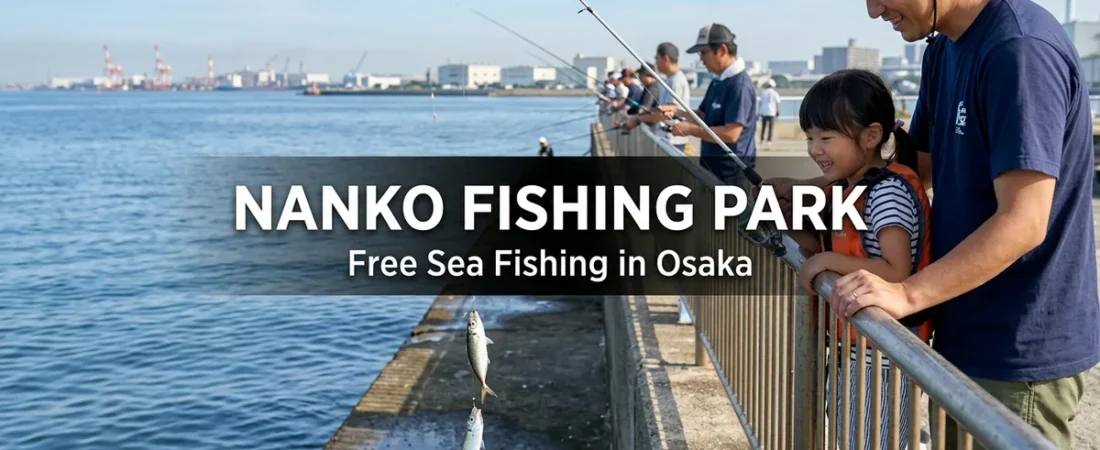
Nanko Fishing Park (南港魚つり園, Nanko Uotsuri-en) is one of the easiest to reach in Osaka. It sits on the Nanko waterfront in Suminoe Ward, where the Yamato River runs into Osaka Bay. Entry is free, the shop rents rods with the rig already tied on, and you can reach it from Namba by train and bus. If you’ve wondered whether you could try sea fishing in Japan with no gear and no Japanese, this is a good place to find out.
This guide explains how to get there, where to fish on the pier, the rules, the facilities, what to expect if you don’t speak Japanese, and how to turn a morning of fishing into a full day around Osaka Bay. Facts come from the park’s official website unless another source is named, and we note where something couldn’t be confirmed.
Nanko Fishing Park at a Glance
| Entry | Free (no adult or child fee) |
| Rental rod | ¥1,000 per rod, sabiki rig included |
| Hours | April–November 5:00–19:00 / December–March 7:00–17:00 |
| Closed | Every Wednesday (open if it’s a public holiday), December 28–January 4, and in bad weather |
| Getting there | Ferry Terminal Station (New Tram) → city bus route 15, about 10 min → Nanko-minami 6-chome stop |
| Parking | About 100 spaces. ¥2,000 for the day if you enter before noon, ¥1,500 from noon |
| Payment | The shop and parking lot take cashless payment (credit cards, PayPay and others) |
| Address | 6-9-3 Nankominami, Suminoe-ku, Osaka (大阪市住之江区南港南6丁目9-3) |
| Phone | 050-1742-4835 (from abroad: +81-50-1742-4835), weekdays 9:00–17:00 |
| Same-day status | Official Instagram: @nanko_uotsuri |
| Official website | https://nankou-uotsuri-en.com/ (Japanese only) |
Two things in this table shape your whole day. The park is closed on Wednesdays, and it can close at short notice for wind, waves, rain or thunder, so check the Instagram account on the morning you go. Both are covered in detail below.
Why Nanko Fishing Park Is the Easiest Way to Sea Fish in Osaka
Free entry and ¥1,000 rental rods
The two other fishing parks in our Osaka Bay fishing guide, in Amagasaki and at Totto Park Koshima, both charge an entry fee. Nanko doesn’t charge anything to walk onto the pier, for adults or children.

Wait, entry is free? So what do I actually end up paying for?

Only what you use: ¥1,000 for a rental rod, plus bait, ice and parking.
Bring your own rod and come by train, and your fares may be your only cost.
What you pay for is what you use. The shop rents rods for ¥1,000 each, and every rental comes with a sabiki rig already attached, so there’s nothing to tie and no tackle to choose. Bait, tackle and ice are sold at the shop. If you bring your own rod, you can fish all day without paying the park at all.
One gap to know about: the shop doesn’t sell live worms such as isome or gokai (ragworms). Sabiki fishing doesn’t need them, but if you’re planning another style of bait fishing, buy worms at a tackle shop in the city before you come.
Sabiki fishing? I’ve never heard of it. What does that mean?
It’s a line with several tiny hooks dressed up to look like little shrimp.
A basket of chum draws in a school, so you can catch a few fish at once.
Staff who walk the pier and help beginners
According to the park, staff walk the pier on patrol and give tips to beginners. Rurubu Kids, a Japanese family travel site that published a report from the park in July 2026, says staff regularly walk the fishing area and talk with visitors, and that the pier was full of families with children on the day they visited. Their report adds a few details that matter if you’ve never fished before:
- Free children’s life jackets in 110 cm and 130 cm sizes.
- A free rig replacement. If your rental rig snags on the bottom and breaks, the shop replaces it once at no charge. Snags are common when you fish near the bottom, so this takes the worry out of your first casts.
- Advice on the spot. Staff will tell you where fish are biting and how to fish. That’s more useful than any written guide, because where the fish are can change through the day.
Rurubu Kids recommends sabiki for families because the rig is simple enough for small children. You fill the little basket with tiny krill-like shrimp (ami-ebi), lower the rig, and move it gently up and down to draw fish in. When a school comes through, you can pull up more than one fish at a time. Rurubu Kids points out the squeeze-tube sabiki bait sold at the shop, which keeps your hands clean. If nothing bites, change the depth: the fish may be near the surface, in midwater or close to the bottom. Japanese anglers call this depth the tana.
Reopened in April 2026
The park closed in December 2025 and stayed shut for about five months. It reopened on April 23, 2026, under new management, and the operator listed on the official website is Housebuild System Co., Ltd. According to Rurubu Kids, the slope from the parking lot to the pier was widened and a new tackle shop opened at the entrance. The shop and the parking lot now take cashless payment, including credit cards and PayPay, so you don’t need a wallet full of coins.
The change of management also means older websites are out of date. Some still say anglers may use two rods, or list a higher rental fee from before the reopening. When a source disagrees with the official website, go by the official website. We’ve used it as the basis for every rule in this guide.
What you can catch, month by month
The park publishes a yearly catch calendar. Treat it as a guide, not a promise: the park says it may change the calendar depending on actual catches.
| Fish | Months on the official calendar |
|---|---|
| Horse mackerel (aji) | May–November |
| Sardine (iwashi) | May–October |
| Chub mackerel (saba) | June–October |
| Cutlassfish (tachiuo) | August–November |
| Yellowtail family (buri-kei) | April–May, September–November |
| Japanese sea bass (suzuki, “sea bass” on the calendar) | All year |
| Black sea bream (chinu) | All year |
| Scorpionfish (gashira) | All year |
| Largescale blackfish (gure) | All year |
| Golden cuttlefish (kōika) | April–June |
| Octopus (tako) | June–August |
For a first-timer with a rental rod, the sabiki season from May to November is the best bet, when horse mackerel, sardines and mackerel come close to the wall. From December to March, the calendar lists only the four year-round fish, which are usually caught with methods other than sabiki. For how each method works across Osaka Bay, see our Osaka Bay fishing guide.
Rurubu Kids says the small horse mackerel, sardines and mackerel from the sabiki season are good as tempura or marinated in vinegar. Fish this small are usually cooked whole, so there’s no filleting to learn.
Osaka’s local fish names
The calendar and the shop’s catch board use the names Osaka anglers actually say, which aren’t always the names in a Japanese dictionary or on a sushi menu. A few you’ll see:
| On the board | Standard Japanese name | English |
|---|---|---|
| チヌ chinu | クロダイ kurodai | Black sea bream |
| ガシラ gashira | カサゴ kasago | Scorpionfish (rockfish) |
| グレ gure | メジナ mejina | Largescale blackfish |
| アコウ akō | キジハタ kijihata | Red-spotted grouper |
| ハネ hane | スズキ suzuki (young) | Young Japanese sea bass |
Some fish also change name as they grow. These are called shusse-uo, “fish that get promoted,” a name that compares them to someone rising through the ranks. The yellowtail is the classic example. In the Kansai region it goes from tsubasu to hamachi to mejiro and finally buri, which is why the park’s calendar simply says “the buri family.” The park’s catch reports use young-fish names too: sanbasō is a young striped beakfish (ishidai), and charikō is a young red sea bream (madai).
Another catch on the board is sappa, a small herring-like fish that Rurubu Kids saw a staff member catch. In Okayama it’s called mamakari, and the name is usually explained as “so good you’ll borrow (kari) rice (mama) from the neighbors to eat more of it.” It’s eaten marinated in vinegar.
How to Get to Nanko Fishing Park
The park is at the southern edge of Osaka’s port district, past the end of the train line. Getting there takes one bus ride after the train, and that bus is the part to plan.
By train and bus from Namba or Umeda
- Take Osaka Metro to Ferry Terminal Station (フェリーターミナル) on the Nanko Port Town Line. Everyone calls this line the New Tram: small driverless trains on an elevated track across the port islands. According to Rurubu Kids, the trip takes about 30 minutes from Namba with one transfer, and about 40 minutes from Umeda with two.
- Leave the station by Exit 3 and walk to the Ferry Terminal Ekimae bus stop (フェリーターミナル駅前).
- Board Osaka City Bus route 15 (15号系統) toward Nanko-minami 6-chome. The ride takes about 10 minutes.
- Get off at Nanko-minami 6-chome (南港南六丁目). The park is right by the stop.
According to the route map on the transit site NAVITIME, route 15 starts at Suminoekoen subway station and ends at Nanko-minami 6-chome, so the park’s stop is the end of the line and you can’t ride past it. Ferry Terminal Ekimae is six stops before the end. The fare is ¥210, and IC cards such as ICOCA are accepted.
The station takes its name from the Osaka Nanko ferry terminal next to it, where overnight ferries leave for Shikoku and Kyushu. It’s a working port, so expect warehouses and trucks around you rather than shops and cafés. There’s no shuttle bus to the park, so plan on the city bus.
Check the return bus first
Rurubu Kids warns that buses here don’t run often, and the timetable bears that out. Buses run several times an hour in the early morning, but only about once an hour from late morning to late afternoon.
These are the departures from Nanko-minami 6-chome back toward Ferry Terminal Station, according to NAVITIME as of October 2026:
| Day | Departures from the park’s stop |
|---|---|
| Weekdays | 6:28, 6:52, 7:20, 7:35, 7:49, 8:02, 8:15, 8:28, 8:41, 9:02, 9:52, 10:41, 11:46, 12:54, 14:04, 15:14, 16:14, 16:59, 17:27, 17:53, 18:21, 18:42, 19:23, 20:07 |
| Saturdays | 7:07, 7:50, 8:14, 8:48, 9:53, 10:53, 11:46, 12:54, 13:53, 14:53, 15:53, 16:54, 17:38, 18:18, 18:56 |
| Sundays and holidays | 7:39, 8:12, 9:01, 10:01, 11:40, 12:40, 13:40, 14:40, 15:40, 16:40, 17:38, 18:22 |
Two things stand out. Around midday the gap between buses is often more than an hour. And on Sundays and holidays the last bus leaves at 18:22, before the park closes at 19:00 from April to November. Stay until closing on a Sunday and you’ll have no bus back.
Going out, weekday buses from Ferry Terminal Ekimae leave several times an hour until about 9:00, then at 9:26, 10:17, 11:21, 12:39 and roughly hourly after that. Timetables change, so check the current times on NAVITIME or Google Maps before you go, and take a screenshot so you have them even if your signal drops.
By car or taxi
- By car: The park recommends leaving Hanshin Expressway Route 4 (Wangan Line) at the Nanko-naka exit, about 10 minutes away. The Nanko-minami exit is about 12 minutes away.
- Parking: About 100 spaces, charged as a day rate by the time you enter. Before noon (0:00–11:59) it’s ¥2,000; from noon (12:00–23:59) it’s ¥1,500. If you arrive in the morning you pay ¥2,000 and stay as long as you like that day. Rurubu Kids notes the lot can fill up on weekends and during long holidays.
- By taxi: Show the driver the address in Japanese: 大阪市住之江区南港南6丁目9-3 (南港魚つり園). Ferry Terminal Station is the closest train station to start from.
Which transit pass to use
All three options below cover the New Tram. For the bus, each says some Osaka City Bus routes are excluded. Osaka Metro names the IKEA Tsuruhama bus and refers to other routes listed in the bus company’s rules; route 15 isn’t named, but we couldn’t find the full list. If the driver doesn’t accept your pass, the fare is only ¥210.
| Pass | What it covers | Best for |
|---|---|---|
| Enjoy Eco Card (Osaka Metro 1-day ticket) | Osaka Metro and Osaka City Bus (some routes excluded). According to Osaka Metro, ¥820 on weekdays and ¥620 on weekends and holidays | A fishing-only day |
| Osaka Metro Pass (Klook) | All Osaka Metro lines; some plans add buses | Booking before your trip |
| Osaka Amazing Pass (Klook) | Osaka Metro, Osaka City Bus (some routes excluded) and private railways within Osaka City, plus free entry to about 40 attractions, including Sakishima Cosmo Tower Observatory | Fishing in the morning and sightseeing in the afternoon |
👉 Get the Osaka Amazing Pass on Klook 👉 Get the Osaka Metro Pass on Klook
The Amazing Pass works on your phone. According to Klook, you start it on the day you use it, it covers trains and buses from the first to the last service that day (it isn’t a 24-hour pass), and you scan a live QR code at the gates. Klook says screenshots of the QR code aren’t accepted, so you need mobile data all day. If you haven’t sorted that out, see our guide to the best eSIM for fishing in Japan.
Where to Fish: The Three Areas of the Pier
The pier runs along the water from the shop at the entrance. According to Rurubu Kids, the park divides it into three areas, named as you stand facing the sea: the Yamato River side on the left, the front in the middle, and the high ground at the far right. The park’s own catch reports use the same names.
Yamato River side (left)
Turn left from the shop to reach the stretch facing the mouth of the Yamato River. Rurubu Kids recommends this area for families and for sabiki fishing, with small horse mackerel, sardines, small mackerel and sappa. The park sits where the river meets Osaka Bay, so the water here is brackish, a mix of river and sea water.
If you’ve rented a rod and just want to catch something, start here.
The front
The middle section is simply called the front (正面, shōmen), and the reports also split it into front left and front right. In the park’s catch reports, the front shows sabiki catches through the day, along with bigger fish. On September 20, 2026, mackerel, horse mackerel and sardines came on sabiki rigs at the front from 6:00. On October 2, a black sea bream of up to 43 cm was caught at the front by nomase fishing, where a small live horse mackerel is used as bait for larger fish.
The high ground (far right)
At the far right end, the pier is a step higher than the rest. Rurubu Kids points it out but doesn’t say what it’s best for, and the catch reports don’t mention it by name, so ask the shop staff on the day.
How to read the park’s catch report
The park posts catch reports on its website regularly, and they’re the most useful thing to check before you go. Each report is a short table listing the fish, the size, the time, the area on the pier and the method. On October 2, 2026, for example:
| Fish | Size | Time | Area | Method |
|---|---|---|---|---|
| Chub mackerel | up to 20 cm | 9:00 | Yamato River side | Sabiki |
| Black sea bream | up to 43 cm | 9:00 | Front | Live horse mackerel bait |
| Red-spotted grouper (akō) | up to 35 cm | 9:00 | Front left | Live sardine bait |
| Horse mackerel | up to 16 cm | 15:00 | Front | Sabiki |
| Japanese anchovy | up to 10 cm | 17:00 | Front | Sabiki |
Read across a few recent reports and you’ll see which part of the pier is producing what, and at what time of day.
Each report also starts with a line of weather and tide information, written in Japanese, such as 晴れ 中潮 満潮11:34/19:45 干潮4:35/15:58. Here’s how to read it:
- 晴れ (hare) is the weather: sunny.
- 中潮 (nakashio) is the tide type. Japanese tide tables name each day by how big the difference between high and low tide is: ōshio (大潮, spring tide, the biggest), nakashio (中潮, medium), koshio (小潮, neap tide, the smallest), and nagashio (長潮) and wakashio (若潮) for the days just after the neap tide.
- 満潮 (manchō) is high tide and 干潮 (kanchō) is low tide, followed by the times.
You don’t need to plan around the tide on your first visit, but Japanese anglers check it the way surfers check a swell forecast. Rurubu Kids notes the shop also posts the day’s high and low tide times and recent catches, so you can ask about both when you rent your rod.
Rules to Know Before You Cast
Pier rules
The rules are short, and the park lists them on its official website:
Do I need some kind of fishing license to fish here, I wonder?
Actually, Japan’s sea fishing rules differ from those for rivers and lakes.
Our fishing license guide explains it, so read it before your trip.
- One rod in the water per person. The park says this is for safety. You can bring as many rods as you like, but only one can be fishing at a time.
- Lures are allowed. Not every fishing park in the region allows lure fishing, so this is a plus if you’ve brought your own spinning rod.
- No long-distance casting. This rule is specific, and the park defines it precisely: bait fishing with a rod of around 4 m built for long casts, the kind anglers use for Japanese whiting (kisu) or flounder (karei) from beaches and breakwaters. A sabiki rig dropped by the wall, or a lure, is fine.
- No smoking anywhere in the park.
- No pets.
- Take your trash home. Public trash bins are rare in Japan, and the park asks everyone to carry out what they bring in, including bait packets and bits of fishing line.
Rurubu Kids adds two more points from its visit: tents are allowed, which helps on hot days, but open flames are strictly forbidden, so no camping stoves or barbecues.
On busy days, anglers stand close together along the wall. Rurubu Kids asks readers to keep an eye on the people around them and to return small fish to the sea, and links to an Osaka Prefecture page that makes the same request about small fish.
Weather closures
The park is an open seawall on Osaka Bay, and it closes when conditions aren’t safe. According to the official website, it may close when:
- waves are higher than 3 m, or a high-wave warning is issued
- the wind is stronger than 20 m/s, or a gale warning is issued
- a storm surge warning, tsunami warning or major tsunami warning is issued
- rain is heavier than 30 mm an hour, or rain, snow or fog cuts visibility below 200 m
- a thunder advisory is issued
The last one catches visitors out. A thunder advisory (kaminari chūihō) is a fairly common alert in Japan in summer, and it can close the park on a day that looks only cloudy. Closures also happen for whole days: the park announced on its website that it would be closed all day on September 21, 2026, as a typhoon approached.
The park posts its same-day status on its official Instagram account (@nanko_uotsuri). Check it on the morning you go, and again before you leave your hotel if the sky looks uncertain.
Facilities and What to Bring
The facilities are basic: a tackle shop in a trailer house at the entrance, toilets, two vending machines and a parking lot. There’s no restaurant and, according to Rurubu Kids, no convenience store or supermarket nearby. Plan as if you’re spending the day on a seawall, because you are.
Shop hours are shorter than park hours on weekdays
This is the detail most likely to trip you up. The shop keeps its own hours, and on weekdays it closes well before the park does.
Wait, so the shop closes before the park does? Why is that?
On weekdays, the shop simply keeps shorter hours than the pier does.
Buy your bait and ice when you arrive, not when you run out.
| Season | Park open | Shop on weekdays | Shop on weekends and holidays |
|---|---|---|---|
| April–November | 5:00–19:00 | 5:30–17:30 | 5:00–19:00 |
| December–March | 7:00–17:00 | 7:30–15:30 | 7:00–17:00 |
The shop is closed on Wednesdays, the same as the park. On a weekday in winter, you could arrive at 13:00 and have only two and a half hours to rent a rod and buy bait. The shop sells tackle, bait, ice and rental rods, and takes credit cards and PayPay.
Toilets, vending machines and food
- Toilets: According to the park, there are two men’s toilets, one unisex toilet and one women’s toilet. Rurubu Kids describes them as portable toilets, with no diaper-changing table or nursing space. A visitor review on the Japanese family site iko-yo says they’re kept clean, but they’re near the entrance rather than out on the fishing area, so allow for the walk.
- Vending machines: Two machines stand next to the shop’s trailer house. Rurubu Kids notes there are none on the fishing area, so buy drinks before you set up.
- Food: The shop sells snacks, and the park’s listing on iko-yo mentions light meals such as cup noodles. Beyond that, bring your own lunch and plenty to drink. A Japanese convenience store lunch of onigiri (rice balls) and a bottle of tea travels well in a cooler bag.
Wi-Fi, phone signal and payments
The park doesn’t mention Wi-Fi, so assume there isn’t any. Your phone matters on this trip: for the bus timetable, the park’s Instagram, a translation app and, if you use one, the Osaka Amazing Pass QR code. Set up mobile data before you leave home; our eSIM comparison for anglers in Japan covers which plans work best near the coast.
For payment, the shop and the parking lot take credit cards and PayPay, but carry some cash for the bus and vending machines in case they don’t take your card.
Packing list
- Sun protection: a hat, sunscreen and sunglasses. The park doesn’t list any shade or shelter on the fishing area. Iko-yo advises bringing heatstroke protection such as a hat, a parasol and a towel.
- A small pop-up tent or sunshade. Rurubu Kids says tents are allowed.
- Water and lunch. There’s no shop nearby beyond the park’s own.
- A cooler bag if you want to keep your catch. The shop sells ice.
- Wet wipes and a towel. Sabiki bait is messy.
- A charged phone and a power bank.
- A light jacket outside midsummer. It’s windier by the water than in the city.
English Support: What to Expect
Will the staff speak English, or is that something to worry about?
The park doesn’t say it offers English, and its website is Japanese only.
Reviewers call the staff friendly, so a translation app goes a long way.
The park’s official website is in Japanese only, and the park doesn’t say anywhere whether staff speak English. We couldn’t find a review from an English-speaking visitor either. What Japanese reviews do say is that the staff are friendly and approachable: Rurubu Kids describes them talking with visitors as they walk the pier, and a reviewer on iko-yo calls them kind.
In practice, renting a rod and buying bait is a short, simple exchange that a few words, pointing and a translation app can handle. A sabiki rig is easy to demonstrate, so gestures go a long way. Don’t plan on a detailed conversation in English, and you won’t be disappointed.
Phrases to show at the shop
Save these on your phone and show the screen at the counter.
| English | Japanese (show this) | Romaji |
|---|---|---|
| One rental rod, please. | 竿を1本借りたいです。 | Sao o ippon karitai desu. |
| Which bait should I use? | どのエサがいいですか? | Dono esa ga ii desu ka? |
| Where are the fish biting today? | 今日はどこで釣れていますか? | Kyō wa doko de tsurete imasu ka? |
| Could you show me how to use this? | 使い方を教えてください。 | Tsukaikata o oshiete kudasai. |
| Ice, please. | 氷をください。 | Kōri o kudasai. |
| Is the park open today? | 今日は開いていますか? | Kyō wa aite imasu ka? |
Japanese words on the catch board
The shop’s board and the website’s catch reports are in Japanese. Fish names are usually written in katakana, which is easier to match by shape than to read:
| Japanese | Romaji | Meaning |
|---|---|---|
| アジ | aji | Horse mackerel |
| サバ | saba | Chub mackerel |
| イワシ | iwashi | Sardine |
| タチウオ | tachiuo | Cutlassfish |
| チヌ | chinu | Black sea bream |
| ガシラ | gashira | Scorpionfish |
| サビキ | sabiki | Sabiki rig |
| 呑ませ | nomase | Live-bait fishing |
| 大和川 | Yamato-gawa | Yamato River side of the pier |
| 正面 | shōmen | The front |
A One-Day Plan: Fishing in the Morning, Osaka Bay in the Afternoon
Nanko Fishing Park sits on the same New Tram line as two well-known sights on Osaka’s waterfront, so a morning of fishing turns easily into a full day. One scheduling tip first: the park is closed on Wednesdays and Sakishima Cosmo Tower Observatory is closed on Mondays, so if you want to do both, go on a Tuesday or from Thursday to Sunday.
| Time | Plan |
|---|---|
| Morning | Bus to the park, rent a rod, sabiki fishing on the Yamato River side |
| Around noon | Check the bus time, pack up, ride back to Ferry Terminal Station |
| Afternoon | New Tram to Trade Center-mae for the observatory, or on to Osakako for the Kaiyukan aquarium |
| Evening | Sunset over Osaka Bay from 252 m, if you chose the observatory |
Morning: sabiki fishing at Nanko
You don’t have to be on the pier at dawn. According to Rurubu Kids, staff say fish can still be caught after 9:00, because early-morning fish are often busy avoiding predators rather than feeding calmly. That makes a 9:00 start from a city-center hotel realistic.
Rent a rod, buy a tube of sabiki bait and a bag of ice, and head left to the Yamato River side. Before you start, look up the return bus times. Give yourself three hours or so on the water, then wash your hands and pack up for the afternoon. Wet wipes do most of the work; the smell of shrimp bait is stubborn.
Afternoon: Sakishima Cosmo Tower Observatory
Ride the bus back to Ferry Terminal Station and take the New Tram a few stops toward Cosmosquare, to Trade Center-mae Station. According to Klook, the tower is about a 3-minute walk from the station.
The observatory is on the 55th floor of the Osaka Prefectural Government Sakishima Building, 252 m above the ground, and looks out over the whole of Osaka Bay. On clear days, Klook’s listing says, you can see as far as Awaji Island and the Akashi Kaikyō Bridge. You ride a glass-walled elevator up to the 52nd floor, then escalators to the 55th. Several Klook reviewers mention that it wasn’t crowded when they went.
- Hours: 11:00–22:00, last entry 21:30. Closed Mondays (the next weekday if Monday is a holiday).
- Regular admission: ¥1,200, according to the Osaka Amazing Pass website.
- With the Osaka Amazing Pass: free entry.
- Food: Klook asks visitors not to bring food or drinks into the observatory. There’s a café on the 55th floor.
If you’re staying into the evening, the observatory is a sunset spot, and the bay lights up as it gets dark.
👉 Book a Sakishima Cosmo Tower Observatory ticket on Klook 👉 Or get the Osaka Amazing Pass, which includes free entry
Klook’s observatory ticket can’t be canceled, and it isn’t valid on January 1 or on the day of the Naniwa Yodogawa Fireworks Festival. If you might change plans, the Amazing Pass, which Klook lets you cancel before you use it, is the safer choice.
Or: Kaiyukan and the Tempozan waterfront
For an aquarium afternoon, stay on the New Tram to Cosmosquare, change to the Chuo Line and ride to Osakako Station. The Kaiyukan aquarium is about a 5-minute walk from there. It’s a natural follow-up to a morning of fishing: the fish you were catching live in Osaka Bay, and the aquarium shows the wider Pacific.
The Amazing Pass covers the Tempozan Giant Ferris Wheel and the Santa Maria day cruise around the bay, but it does not cover the Kaiyukan, so you need a separate ticket.
👉 Book Kaiyukan tickets on Klook 👉 Book Kaiyukan tickets on KKday
For bird lovers: Osaka Nanko Bird Sanctuary
The Osaka Nanko Bird Sanctuary (大阪南港野鳥園) is a man-made tidal flat on the port islands. According to Osaka City, it opened in 1983 as Japan’s first artificial tidal flat, and about 150 kinds of wild birds visit in a year. In spring, shorebirds such as sandpipers and plovers stop there to feed on their way north from Australia and Southeast Asia to breeding grounds in Russia and Alaska. From the observation tower you can look out over the tidal flat, and Osaka City says that on clear days you can see Awaji Island, the Akashi Kaikyō Bridge and the Rokko mountains.
- Getting there: About 1.1 km, roughly a 13-minute walk, from Exit 3 of Trade Center-mae Station along the Nanko green walkway, according to Osaka City.
- Observation tower: 9:00–17:00. Closed on Wednesdays (open on public holidays) and on January 1.
- Entry: Free.
The tower is closed on Wednesdays, the same day as the fishing park, so the two fit into the same day plan.
FAQ
Is Nanko Fishing Park the same place as Nanko Uotsuri-en?
Yes. The Japanese name is 南港魚つり園 (Nanko Uotsuri-en), which translates roughly as “Nanko fishing garden.” Osaka’s official tourism website lists it as “Uotsuri-en Gogan (Osaka City Nanko Uotsuri-en Fishing Garden),” and some sites call it Osaka Nanko Fishing Park. Some of that older information dates from before the park reopened in April 2026, so check the current rules on the official website.
How much does it cost?
Entry is free for everyone. A rental rod with a sabiki rig is ¥1,000. Bait, tackle and ice are extra, and parking is ¥2,000 for the day if you arrive before noon or ¥1,500 from noon.
What days is Nanko Fishing Park closed?
Every Wednesday (it opens if Wednesday is a public holiday) and from December 28 to January 4. It can also close on any day for bad weather.
Is it open in the rain?
It depends on how heavy the weather is. The park closes when rain is heavier than 30 mm an hour, when rain or fog cuts visibility below 200 m, or when a thunder advisory is issued. Check the official Instagram (@nanko_uotsuri) on the day.
Can I fish at night?
No. The park closes at 19:00 from April to November and at 17:00 from December to March. According to Rurubu Kids, the gate is closed outside opening hours.
Do I need my own fishing gear?
No. Rental rods cost ¥1,000 and come with a sabiki rig attached. The shop sells bait and tackle, but not live worms. Remember that the shop closes earlier than the park on weekdays.
Is it good for kids?
According to Rurubu Kids, it’s popular with families. Children’s life jackets are lent free in 110 cm and 130 cm sizes, and the slope from the parking lot is wide enough for strollers. The toilets are portable units with no diaper-changing table or nursing space.
Can I take my fish home and eat it?
The park’s rules don’t mention any limit on keeping fish, and the shop sells ice, so bring a cooler bag if you plan to take your catch home. Rurubu Kids asks readers to return small fish to the sea. If you eat fish raw, be aware of anisakis, a parasite found in many sea fish. Japan’s Ministry of Health, Labour and Welfare says the larvae are killed by cooking at 70°C or higher (or 60°C for one minute) or by freezing at −20°C for at least 24 hours. It also says vinegar, salt, soy sauce and wasabi don’t kill them.
How long does it take from Namba?
According to Rurubu Kids, about 30 minutes to Ferry Terminal Station with one transfer, then about 10 minutes on the bus. Add time for waiting at the bus stop: from late morning, buses run only about once an hour.
Does the park have Wi-Fi?
The park doesn’t mention Wi-Fi. Bring your own mobile data, especially if you use an Osaka Amazing Pass, which needs a live QR code.
Plan Your Day at Nanko
Nanko Fishing Park asks very little of you: no entry fee, no gear, no boat and no booking. Rent a rod for ¥1,000, follow the staff’s tips to the Yamato River side, and watch the shop’s catch board to see what’s biting. The planning that matters is small. Check the park’s Instagram on the morning you go, note the return bus time when you arrive, buy your bait before the weekday shop closes, and bring mobile data, water and sun protection.
Then take the afternoon to see the bay you’ve been fishing from 252 m up, or meet its fish at the Kaiyukan.
- 👉 Get the Osaka Amazing Pass on Klook: trains and buses for the day, plus free entry to Sakishima Cosmo Tower Observatory
- 👉 Book a Sakishima Cosmo Tower Observatory ticket on Klook
- 👉 Book Kaiyukan tickets on Klook
- 👉 Find the best eSIM for fishing in Japan
Want to compare Nanko with the other fishing parks on Osaka Bay, or see which fish each season brings? Read our Osaka Bay fishing guide.