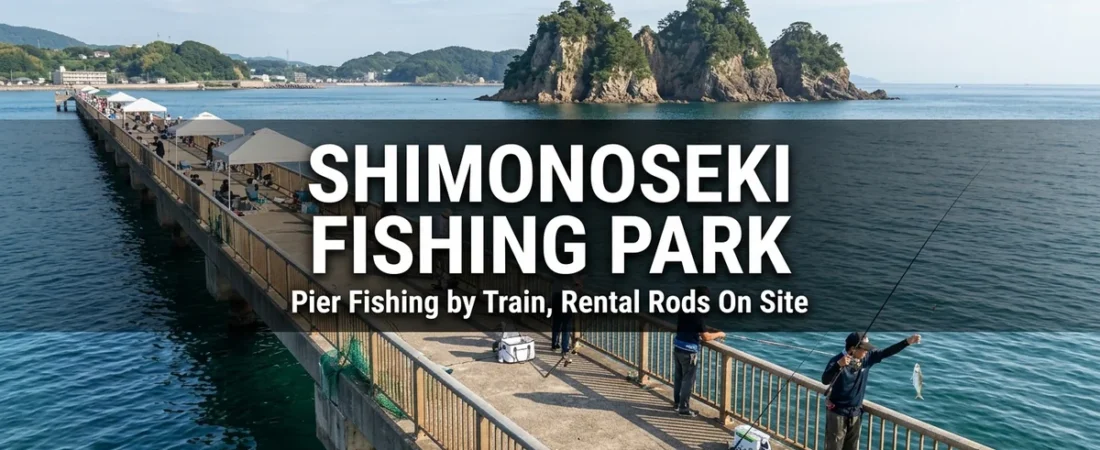
Shimonoseki sits at the far western tip of Honshu, Japan’s main island, where the narrow Kanmon Strait separates it from Kyushu. Most travelers know it for blowfish (fugu) and the busy fish market at Karato. Fewer know that a short local train ride north of the city, on the quieter Sea of Japan coast, there is a public fishing pier where you can rent a rod, buy bait, and fish over deep water for under ¥2,000.
That pier is Shimonoseki Fishing Park (下関フィッシングパーク). A 100 m fishing deck stands about 200 m out at sea, staff are on duty all day, and the nearest station is on a JR line. You don’t need your own gear, a car, or a reservation.
This guide covers how to get there by train or rental car, what it costs, the rules that surprise visitors from abroad, what to do if you don’t speak Japanese, and how to turn a morning of fishing into a full day of Shimonoseki’s food and sea views.
Quick facts (checked October 2026):
- Fee: ¥830 for up to 4 hours, or ¥1,250 for the whole day (adults). Free for children under elementary school age.
- Rental rods: ¥1,000 with a sabiki rig, ¥700 without.
- Hours: 5:00–20:00 from May to October. Shorter hours in other months (see below).
- Closed: Tuesdays, December 30–January 1, and days with bad weather.
- Nearest station: Yoshimi (吉見) on the JR San’in Line, about a 15-minute walk.
- Reservations: Not needed.
Prices, hours and rules in this guide come from the park’s official website and were checked in October 2026. They can change, so check again shortly before your trip.
Why Shimonoseki Fishing Park Is Worth the Trip
Japan has many umizuri kōen (海釣り公園), public sea-fishing parks run by cities and towns. Many have rental rods, a shop and staff on site, and they’re a common place for families to take children fishing. For a traveler, they are one of the easiest ways to try sea fishing in Japan: the rules are posted, the staff keep an eye on everyone, and the fish come to you.
Shimonoseki Fishing Park has been one of these places since June 1985. It is a public facility of Shimonoseki City, and it shows the qualities that make a good fishing park: a sturdy pier over deep water, a shop on site, and people on hand to help.
A 100 m Pier Built 200 m Out at Sea
A lot of shore fishing in Japan happens from breakwaters and seawalls, where the water at your feet can be shallow. Here the fishing deck has been built out into the sea. According to Yamaguchi Prefecture’s official tourism site, the deck is 100 m long, stands about 200 m off the coast, and has an average water depth of about 10 m below it.
That depth matters. You don’t need to cast far to reach fish, because you are already standing over open water. You simply drop your rig straight down, which is exactly how the park wants you to fish (more on the rules below).
The pier has tents for shade and shelter from rain, which makes a real difference on a July morning or a drizzly autumn day. The facility also has a shop, toilets and, according to the park’s Google Maps page, a rest area. Staff work from the management office throughout opening hours.
From the shore near the park, you can see Kamo Island (加茂島), a rugged rock that looks like three separate pinnacles rising from the sea. More on that in the day-plan section.
What Local Anglers Say
We couldn’t find any English-language reviews of the park, and it isn’t listed on TripAdvisor. That isn’t a bad sign. It simply means that, for now, this is a place used mostly by local and Japanese anglers. Their opinions are a good guide to what you’ll find.
According to Google Maps reviews, the park has a rating of 3.9 out of 5 from 173 reviews (October 2026). The same points come up again and again:
- Friendly staff. Several reviewers say the staff were polite and explained how to fish when they weren’t sure what to do.
- Good for families. One reviewer notes that other anglers don’t mind children, so families can fish without feeling out of place.
- The view. People mention the scenery and how pleasant it feels to fish there.
- A sink to clean your catch. There is a washing area where you can gut fish and rinse your gear before heading home.
- Busy weekends. Weekends and public holidays are crowded, while weekday visitors describe a quiet pier.
Some reviewers also mention fishing here on a business trip or while traveling in Shimonoseki, renting a rod for a couple of hours.
Shimonoseki City itself recommends the park to visitors from abroad: its English tourist leaflet lists the “Fishing Park” as a place where even beginners can fish casually.
What You Can Catch
The park’s official catch calendar lists these fish:
- Horse mackerel (aji, アジ)
- Mackerel (saba, サバ)
- Sardines (iwashi, イワシ)
- Halfbeak (sayori, サヨリ)
- Young Japanese sea bass (fukko, フッコ). In Japan, sea bass take different names as they grow, and fukko is the mid-sized stage.
- Rockfish (mebaru, メバル)
- Fat greenling (ainame, アイナメ)
- Flounder (karei, カレイ)
For a first-timer, horse mackerel, mackerel and sardines are the fish to aim for. They swim in schools and bite on a sabiki rig: a line of small hooks dressed with tiny lures, with a basket of chum above or below. You fill the basket with tiny krill-like shrimp called ami-ebi, drop it down, and give it a gentle shake. When a school arrives, you can bring up several fish at once.

Wait, can I really show up with no gear and still fish?

Yes, you can rent a rod at the counter. Bait and sabiki rigs are sold in the shop too.
On Google Maps, one reviewer who visited in late June describes plenty of small horse mackerel (10–15 cm) and mackerel around 25 cm on a sabiki rig with a rental rod.
The park also holds events. In past years these have included a black sea bream (chinu) derby in April and a bigfin reef squid (aori-ika) derby in May and June, plus sabiki fishing classes for children.
How to Get to Shimonoseki Fishing Park
The park is in Yoshimi (吉見), a small fishing town on the coast north of central Shimonoseki. You can reach it by local train or by car. Which one suits you depends on where you are staying and whether you want to combine fishing with other stops.
By Train: Shimonoseki Station → Yoshimi Station → 15-Minute Walk
- Take the JR San’in Line from Shimonoseki Station to Yoshimi Station (吉見). The ride takes about 25 minutes. Trains on this stretch are all local trains, and the ones from Shimonoseki stop at Yoshimi whatever their final destination (Kogushi, Takibe or Nagatoshi, for example).
- Walk to the park. The official site gives about 15 minutes on foot from Yoshimi Station. (Some tourism sites say 10 minutes, but we’ve gone with the park’s own figure.)
The San’in Line here is a quiet rural line, not a busy city railway. Trains run roughly once an hour, and in the middle of the day and in the evening the gap between trains can stretch to well over an hour. There are only local trains on this stretch, so there’s no faster option to miss.
Only about one train an hour? What if I miss my train back?
Then you could be waiting an hour or more for the next one. That’s why it pays to plan your return before you start.
So make one habit part of your day: check your train back before you start fishing. Look up the times on JR West’s official timetable on the morning of your trip, and work out when you need to pack up. A 4-hour ticket is counted from check-in until you return your card at the counter, so leave time to rinse your gear, hand back the rental rod and walk 15 minutes to the station.
Getting to Shimonoseki First
Many travelers come to Shimonoseki from Fukuoka, Kyushu’s biggest city, which has the region’s main international airport. According to Japan Guide, there are two quick ways to make the trip by train from Hakata Station:
I’m staying in Fukuoka. Is it too far for a day trip?
It works as a day trip. By car it’s about an hour from Kitakyushu Airport, or roughly an hour and a half from Fukuoka Airport.
According to Japan Guide, there are two quick ways to make the trip by train from Hakata Station:
- Shinkansen to Shin-Shimonoseki: About 25 minutes from Hakata to Shin-Shimonoseki Station, then about 10 minutes on a local train to Shimonoseki Station.
- Via Kokura: Take the shinkansen from Hakata to Kokura, then a local train under the Kanmon Strait to Shimonoseki. The Kokura–Shimonoseki leg takes about 15 minutes.
If you’re traveling across western Japan, between Osaka, Hiroshima and Fukuoka, a regional rail pass can cover the long legs of your trip.
- JR Sanyo-San’in Area Pass:
- Covers the Sanyo Shinkansen between Shin-Osaka and Hakata, which stops at Shin-Shimonoseki.
- Only for foreign passport holders entering Japan as temporary visitors.
- JR West’s coverage map also shows the JR line from Shimonoseki north along the coast toward Nagato and Hagi, which is the San’in Line that stops at Yoshimi. Check the map yourself before you buy.
👉 Get the JR Sanyo-San’in Area Pass on Klook
By Rental Car from Kitakyushu or Fukuoka Airport
A car gives you more freedom with the hours. You can arrive for the 5:00 opening in summer, when the trains aren’t running yet, and carry a cooler of fish home without worrying about a train. The park has a free parking lot.
From Kitakyushu Airport: about 57 minutes and 58 km, using toll roads (Google Maps, checked on a Saturday morning in October 2026). 👉 See the route from Kitakyushu Airport on Google Maps 👉 Compare Kitakyushu Airport rental cars on EconomyBookings
From Fukuoka Airport: about 1 hour 36 minutes and 108 km, using toll roads (same check). 👉 See the route from Fukuoka Airport on Google Maps 👉 Compare Fukuoka Airport rental cars on EconomyBookings
From the Shimonoseki IC expressway exit: about 30 minutes, according to the park. Follow National Route 191 and turn west at the Furushuku (古宿) intersection; the park is about 700 m from there.
Driving times change with traffic, so check the live route on the day. To drive in Japan, you need an International Driving Permit issued under the 1949 Geneva Convention or, for some countries, an official Japanese translation of your license.
Prices, Rental Rods and the On-Site Shop
As a city-run facility, the park keeps its prices low: a 4-hour ticket costs less than ¥1,000.
Ticket Prices
When you arrive, you pay at the counter and choose your course. You receive a card, which you hand back when you leave.
| Ticket | Adults | Elementary & junior high students |
|---|---|---|
| Up to 4 hours | ¥830 | ¥410 |
| Whole day | ¥1,250 | ¥620 |
| Each extra hour | ¥210 | ¥100 |
| Watching only (no fishing) | ¥210 | ¥100 |
- Children under elementary school age get in free.
- Groups of 20 or more get 10% off.
- How the 4 hours are counted: From check-in until you return your card at the counter. According to the park’s FAQ, staff may allow about 10 minutes over, at their discretion.
- Changing your course: You can’t switch from the 4-hour ticket to the whole-day ticket once you’ve checked in. If you think you’ll stay longer, extra hours are charged instead.
- Stepping out: You can leave the park and come back during your time, as long as you tell the staff.
The 4-hour ticket fits most travelers. It’s enough to learn how a sabiki rig works and, if the fish are in, fill a small cooler.
Opening Hours by Month
| Months | Hours |
|---|---|
| April | 6:00–19:00 |
| May–October | 5:00–20:00 |
| November | 6:00–18:00 |
| December–March | 7:00–17:00 |
The park is closed every Tuesday. If a Tuesday is a public holiday, the park opens and closes on the next day that isn’t a holiday instead. It’s also closed from December 30 to January 1, and on days when the weather is bad.
Rental Rods, Bait and the Shop
- Rental rod with a sabiki rig: ¥1,000
- Rental rod without a rig: ¥700
If you’ve never fished in Japan, take the rod with the rig. You’ll get a rod ready to fish, and you only need to add bait.
The on-site shop sells what you need for a day on the pier:
- Bait: frozen ami-ebi chum for sabiki fishing, and frozen krill.
- Rigs: sabiki rigs, bottom rigs and weights.
- Keeping your catch: ice and cooler boxes.
- Basics: wet wipes and towels.
- Snacks: ice cream, chips and cup noodles, with hot water provided for the noodles.
The park changed its shop prices and added new items on October 1, 2026, so we haven’t listed individual prices here. Expect to pay a few hundred yen for a pack of bait or a rig.
According to one Google Maps reviewer, the shop’s krill comes in small packs. If you plan to fish all day, they suggest buying extra bait at a tackle shop before you arrive.
Payment and What to Bring
We couldn’t confirm whether the counter and shop accept cards or mobile payments; neither the official site nor the reviews we read mention it. Bring enough cash in yen to cover your ticket, rod rental and bait. Around ¥3,000 per person covers a 4-hour ticket, a rental rod with a rig and a pack of bait, with some to spare.
Also pack:
- Sun protection: a hat, sunscreen and sunglasses. The pier has tents, but you’ll spend time in the open.
- Water and snacks, especially in summer.
- A towel and wet wipes. Sabiki chum is messy.
- Plastic bags, or a small cooler if you plan to take fish back.
- A warm layer for early mornings, even in spring and autumn. Sea wind is cold.
Rules to Know Before You Fish
Fishing parks in Japan run on clear, posted rules, and staff do enforce them. The official rules say that if you don’t follow the staff’s instructions, you may be asked to leave. Most rules are about sharing a crowded pier safely, and a few may differ from what you’re used to at home.
How you can fish
- No casting and no lures. Long casting (nage-zuri) and lure fishing are both prohibited. You fish by dropping your rig down from the pier.
- Up to 2 rods per person. The rule says no more than two lines in the water.
- Fish only from the fishing deck, not from other parts of the facility.
- No red clay, sand or barley mixed into chum.
No lures at all? That’s how I always fish back home.
Casting and lures are against the park’s rules. Most people drop sabiki rigs straight down below the pier instead.
With about 10 m of water under the pier, a rig dropped straight down already puts your bait in deep water.
Safety
- Children in elementary school or younger can’t enter without a companion aged 18 or older.
- Life jackets: Children in elementary school or younger must wear one. Adults bringing small children are also asked to wear one. The park lends them for free.
- Don’t run on the deck.
- No fishing if you’ve been drinking. Visitors who have been drinking alcohol are turned away.
- Weather announcements: If the office broadcasts a warning about wind, waves or lightning, follow the staff’s instructions.
Shared space
- No pets and no dangerous items.
- No fires or fireworks.
- Litter: put it only in the designated places.
- Selling, fundraising, posting flyers or advertising need permission.
Closures and crowds
- Weather closures: The park closes when warnings for strong wind, high waves or dense fog are issued, during tsunami advisories, and whenever staff judge it dangerous.
- No refunds: Once you’ve checked in, fees aren’t refunded, even if the park closes early. If the weather looks uncertain, the park asks you to check the forecast with staff before you pay.
- Crowd limits: On crowded days such as Sundays, entry may be limited. In season, arrive early on weekends and holidays.
If you have questions about fishing licenses or catch rules outside the park, see our separate guide. 👉 Do you need a fishing license in Japan?
Is There English Support?
Let’s be honest about this: the park’s official website is in Japanese only, and we found no information about English-speaking staff. This is a local municipal facility, not a tour aimed at international visitors, so plan as if you’ll be communicating in simple Japanese and gestures.
That said, there are good reasons not to let it put you off.you’ll be communicating in simple Japanese and gestures.
- The process is simple. You pay at the counter, choose 4 hours or a whole day, rent a rod, buy bait and walk out onto the pier. There aren’t many decisions to make.
- The staff are known for helping. According to Google Maps reviews, staff explain how to fish when visitors aren’t sure what to do. Pointing at a rod and a pack of bait goes a long way.
- The rules are visual. Once you’re on the pier, you’ll see how everyone else is fishing: rigs dropped straight down, nobody casting.
Before you go:
- Get mobile data so you can use a camera translation app on signs and price lists, and check train times on the pier. We found no information about free Wi-Fi at the park. 👉 Get a Japan eSIM on Saily 👉 How to choose an eSIM for fishing trips in Japan
- Check the catch report. The park updates its catch information on the official website, and posts on Instagram and X. Running these through a translation app tells you what’s biting and which rig people are using.
- Bring cash, so you don’t have to ask about payment methods.
I don’t speak Japanese. Will I be able to get help?
The park’s website is Japanese only, so English isn’t guaranteed. A translation app and a few key phrases will help a lot.
Useful phrases at the counter:
| Japanese | Pronunciation | Meaning |
|---|---|---|
| 4時間でお願いします | Yo-jikan de onegai shimasu | Four hours, please. |
| 1日でお願いします | Ichi-nichi de onegai shimasu | The whole day, please. |
| 竿を借りたいです | Sao o karitai desu | I’d like to rent a rod. |
| サビキ仕掛け付きで | Sabiki-shikake tsuki de | With a sabiki rig. |
| 何が釣れていますか? | Nani ga tsurete imasu ka? | What’s biting today? |
| 釣り方を教えてください | Tsurikata o oshiete kudasai | Could you show me how to fish? |
A One-Day Plan and Real Japanese Experiences Nearby
Fishing at Shimonoseki Fishing Park is best done in the morning, when the park opens early and the pier is cool. That leaves the afternoon free, and Shimonoseki is a city built around the sea and what comes out of it. Here’s how to fill the rest of your day.
Kamo Island, the Three-Peaked Rock
You don’t need to go anywhere for the first sight. From the shore near the park, look out to sea for Kamo Island (加茂島). According to Japan Travel by JAL, it looks like three separate rocks rising out of the water, but it’s actually a single island with three rugged, tree-covered peaks. It makes a good backdrop for a photo of your catch.
Karato Market’s Weekend Sushi Stalls
Shimonoseki is famous across Japan as the home of fugu (blowfish), and Karato Market (唐戸市場) is where the city’s love of seafood is easiest to see. It’s a working fish market that also welcomes visitors.
On Fridays, Saturdays, Sundays and public holidays, the market holds Iki Iki Bakangai (活きいき馬関街), when stalls line the market floor selling sushi and seafood bowls. According to Yamaguchi Prefecture’s tourism site:
- Fridays and Saturdays: 10:00–15:00
- Sundays and holidays: 8:00–15:00
- Getting there: About 10 minutes by bus from JR Shimonoseki Station to the Karato stop, then a 6-minute walk.
The stalls close at 15:00, so this works best after a morning on the pier. After catching small fish yourself in the morning, it’s a fun contrast to see what Shimonoseki’s professional fishers bring in.
Kawatana Onsen and Kawara Soba
If you’d rather relax than sightsee, stay on the San’in Line. Kawatana-Onsen Station is about 15 minutes further up the line from Yoshimi, away from central Shimonoseki.
Kawatana Onsen (川棚温泉) is a hot spring town that local guides say has about 800 years of history. From the station, it’s about 3 minutes by bus plus a 5-minute walk, or about 5 minutes by taxi.
The town is also the birthplace of kawara soba (瓦そば). According to Yamaguchi Prefecture’s tourism site, it was created in Kawatana Onsen in 1962:
- The dish: Green tea soba noodles are served on a hot roof tile (kawara), topped with beef, thin strips of egg, green onion, seaweed, lemon and grated daikon with chili.
- How to eat it: The noodles touching the tile turn crisp, and you dip them in a special broth.
- The story behind it: Soldiers in the 1877 Satsuma Rebellion are said to have grilled wild plants and meat on roof tiles.
A soak in a hot spring after an early start on a windy pier is hard to beat.
Across the Strait: Mojiko and the Kanmon Strait Museum
From Karato Pier, a small ferry crosses the Kanmon Strait to Mojiko (門司港) in Kitakyushu, on the island of Kyushu.
- The ferry: The crossing takes about 5 minutes. According to Mapple, it runs about every 20 minutes during the day.
- Kanmon Strait Museum: A museum about the strait you’ve just crossed, about a 5-minute walk from Mojiko Station. According to Klook, it’s open 10:00–17:00.
👉 Book Kanmon Strait Museum tickets on Klook (no cancellations or refunds)
A Sample Weekend Day
This plan uses the train and works on a Friday, Saturday, Sunday or public holiday, when the Karato Market stalls are open. Check train times on JR West’s timetable before you go.
- Early morning: Take a San’in Line train from Shimonoseki to Yoshimi and walk to the park.
- Morning: Fish on a 4-hour ticket with a rental rod and sabiki rig.
- Late morning: Return your rod, rinse your hands and gear, and walk back to Yoshimi Station in time for your train.
- Lunch: Ride back to Shimonoseki, take the bus to Karato, and eat at the Iki Iki Bakangai stalls before they close at 15:00.
- Afternoon: Take the ferry to Mojiko, visit the Kanmon Strait Museum, and walk around the old port.
If you’re there on a weekday, swap the market for Kawatana Onsen: after fishing, ride the train north instead of south, and finish with kawara soba and a hot spring bath.
FAQ
Do I need to book Shimonoseki Fishing Park in advance? No. In a post on its Google Maps page, the park says you don’t need a reservation and can come whenever you like. On weekends and public holidays in season, entry may be limited when the pier is crowded, so arrive early.
Do I need a fishing license to fish here? See our guide to fishing license rules in Japan: Do you need a fishing license in Japan?
How much does it cost in total? For one adult, a 4-hour ticket is ¥830 and a rental rod with a sabiki rig is ¥1,000. Add bait from the shop, and around ¥3,000 in cash should cover it.
Can I fish when it rains? The pier has tents for shade and rain, so light rain isn’t a problem. However, the park closes when storm, wave or dense fog warnings or a tsunami advisory are issued, and fees aren’t refunded after check-in.
Can I take my fish home? Yes. The shop sells ice and cooler boxes, and reviewers mention a sink where you can clean your fish and rinse your gear.
Is the park open in winter? Yes, from 7:00 to 17:00 between December and March. It’s closed on Tuesdays and from December 30 to January 1.
Can children fish here? Yes. Children in elementary school or younger must come with someone aged 18 or older and wear a life jacket, which the park lends for free. Children under elementary school age get in free.
Can I use lures? No. Lures and long casting are prohibited. Most visitors fish with sabiki rigs dropped straight down from the pier.
Plan Your Trip to Shimonoseki Fishing Park
Shimonoseki Fishing Park is one of the easiest ways to try sea fishing in western Japan without packing a rod. You can rent everything on site, a 4-hour ticket plus a rental rod costs under ¥2,000, and you can get there by local train. Afterwards, Shimonoseki’s seafood, the Kanmon Strait and a historic hot spring town are all close by.
Sort out the travel before you go:
- Getting to Shimonoseki by Shinkansen: 👉 Get the JR Sanyo-San’in Area Pass on Klook
- Driving from Kitakyushu Airport: 👉 Compare Kitakyushu Airport rental cars on EconomyBookings
- Driving from Fukuoka Airport: 👉 Compare Fukuoka Airport rental cars on EconomyBookings
- Staying connected for train times and translation: 👉 Get a Japan eSIM on Saily
- Adding the Mojiko side of the strait: 👉 Book Kanmon Strait Museum tickets on Klook