Last checked: October 24, 2026
Staying in Kyoto, with Lake Biwa next door and a rod in your bag? Read this before your first cast.
You don’t need a national license to fish Kansai’s rivers and lakes with a rod. But many rivers sell day tickets through a local fishing co-op. Each prefecture sets its own seasons and size limits. Shiga also has a bass rule we found nowhere else. We cover rivers and lakes in Osaka, Kyoto, Nara, Shiga, Hyogo, Wakayama and Mie. For the sea, see our guide to Kansai sea fishing rules.
We built this guide from each prefecture’s regulations, notices and booklets, plus co-op announcements. We say so when we couldn’t confirm something. Dates and prices change every year, so check with the co-op before you go.
At a Glance
- National license: None needed for rod fishing
- Day ticket: Needed wherever a local fishing co-op holds the fishing rights, in all seven prefectures
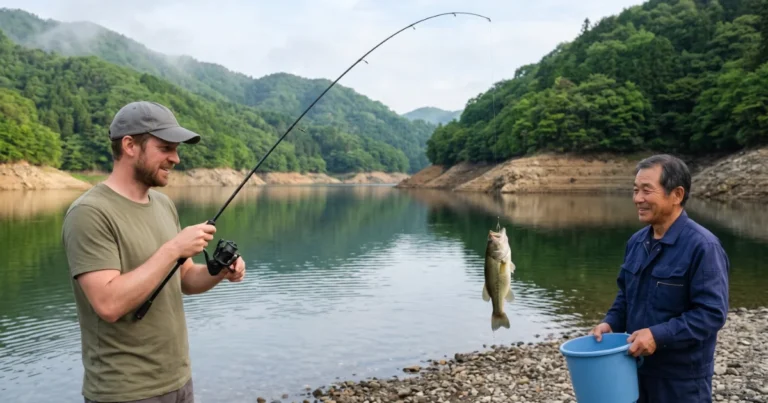
- Lake Biwa: The main lake isn’t on Shiga’s Lake Biwa-district list of fishing rights that charge anglers. Bass and bluegill can’t be put back in the water
- Stream trout: Closed from October 1 in six prefectures. Osaka’s regulation sets no closed season
- Ayu: Each prefecture closes it on different dates. Shiga closes it from late summer to autumn. The others close it mainly from winter or early spring until May
- Fines: Up to six months in prison, a fine of up to ¥100,000, or both, for most rule breaks. Up to ¥1,000,000 for fishing rights violations
Who This Guide Is For
- You plan to fish Lake Biwa from shore or from a boat
- You plan to fish a mountain stream for trout, or a river for ayu (sweetfish), anywhere in Kansai
- You plan to use a rod or a handline. We leave out nets and other gear
- You want the sea instead? Our sea rules guide covers it
For Mie, we cover rivers on the Kumano-nada coast only. The Ise Bay side is outside this guide.
Do You Need a License or a Ticket?
You don’t need a national license. Japan has none for rod fishing. Our guide to fishing licenses in Japan has the full picture.
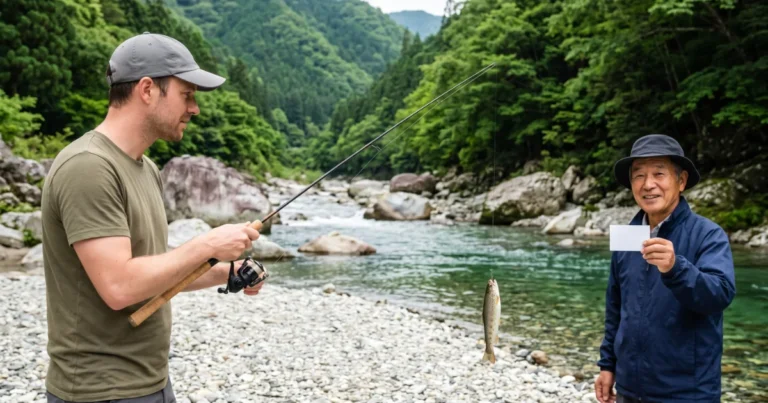
Rivers and lakes with a fishing right are different. A local co-op holds the right, and you buy its day ticket. This applies in all seven prefectures. A river without a fishing right is another story, and the prefectures are less clear:
- Kyoto lists the gear you may use in waters without fishing rights: rods, dip nets, scoop nets and baskets. Cast nets need a permit
- Wakayama lists rods, dip nets, cast nets and crab pots for waters without fishing rights
- Three areas lack a clear statement: Osaka’s rivers outside its five fishing-right rivers (including the Yodo and Yamato), Lake Biwa’s main body, and Mie’s small rivers with no fishing right. We couldn’t find a prefecture page that says “no ticket needed” in one line
Our pick: buy your ticket before you reach the water. Wakayama’s river federation page for the Kishi River says to buy ahead if you arrive early, and that bait and tackle aren’t sold at the river. Hyogo’s co-op rules also say to carry your ticket and show it when a monitor asks.

Can I just pay at the river?

Many co-op rules allow it, but some add a surcharge. Kyoto co-op rules allow up to 20% extra on annual tickets and up to 50% on day tickets. Osaka’s Akuta River co-op adds ¥1,000.
Where to Buy a Day Ticket
This table shows what we found for each prefecture.
| Prefecture | Online | Shops and convenience stores |
|---|---|---|
| Osaka | – | – |
| Nara | FISHPASS, Tsurichike | Lawson (one co-op), FamilyMart in Iga, Mie (three co-ops), decoy and tackle shops |
| Kyoto | Tsurichike, FISHPASS | Miyama co-op lists shops in town |
| Shiga | Tsurichike, FISHPASS | – |
| Hyogo | FISHPASS, Tsurichike | Lawson and FamilyMart (Kishida), 24 outlets besides the co-op office (Maruyama) |
| Wakayama | FISHPASS, Tsurichike | Kishi River: a local facility, a camp site and tackle shops |
| Mie | FISHPASS | Omata River: three shops |
Source: Tsurichike and FISHPASS listings (checked November 2026), co-op websites and prefecture committee documents (checked October 2026). Only some co-ops in each prefecture sell online, and the lists change, so search your river on both sites. A dash means we found none. Tsurichike says it doesn’t sell tickets for Osaka.
FISHPASS needs a member registration. We couldn’t confirm that an overseas phone number or address works, or that it has English support. Its support line is in Japanese: 0776-67-7335, weekdays 9:00–12:00 and 13:00–17:00. Its email is support@fishpass.co.jp. Wakayama’s river federation says neither it nor the co-ops can help with FISHPASS questions, so contact FISHPASS directly.
Some Tsurichike co-ops ask you to print the e-ticket. Kyoto’s Hozu River co-op has required it since 2025, and the Uji River co-op’s ticket page also describes printing. The Kamo River co-op says you don’t need to print. If you can’t print, we’d check the Kamo River co-op first. Its ticket page lists ayu and small-fish day tickets, but the amago ticket wasn’t on the list when we looked.
Seasons: When Each Fish Opens and Closes
This table shows when each prefecture’s regulation says you can’t take ayu or stream trout. A co-op sets its real season each year, and it can be shorter.
| Prefecture | Ayu closed | Stream trout closed |
|---|---|---|
| Osaka | January 1 – May 24 | No closed season in the regulation |
| Nara | January 1 – May 25 | October 1 – end of February |
| Kyoto | March 1 – May 25 | October 1 – end of February |
| Shiga | August 21 – November 20 | October 1 – November 30 |
| Hyogo | January 1 – May 25 | October 1 – end of February |
| Wakayama | January 1 – April 30 | October 1 – end of February |
| Mie | January 1 – May 10 | October 1 – end of February |
Source: Prefecture fisheries regulations and committee notices for Osaka, Nara, Kyoto, Shiga, Hyogo, Wakayama and Mie, checked October 2026. “Stream trout” means amago, yamame and iwana (whitespotted char), plus other trout (except rainbow trout) in Hyogo, and rainbow trout in Wakayama’s Kumano River system.
These exceptions matter:
- Kyoto: Rivers that flow into the Sea of Japan are also closed to ayu from October 1 to 31, rods included, except the Yura River above Wachi Dam. Iwana stays closed until March 15
- Shiga: The closure covers Lake Biwa too. From August 21 to 31, rods, handlines and dip nets are still allowed. The prefecture says paid river waters run by co-ops are exempt
- Shiga biwa trout: Fish over 25 cm are closed from October 1 to November 30
- Wakayama: Ayu fishing is closed in spawning areas on eight rivers from October 11 to December 10
- Wakayama and Mie: In the Kumano River system, ayu stay closed until May 25. In Mie, the Omata River follows the May 10 date
- Hyogo: On a set stretch of the Kako River (闘竜灘), rod ayu fishing is closed January 1 to April 30 only. The lowest stretch of the Muko River is outside the January–May closure
The table is the regulation. Co-ops open each river on their own dates. Here are the 2026 opening days for a few co-ops.
| Co-op (river) | Amago opened | Ayu opened |
|---|---|---|
| Tenkawa village (天川村), Nara | March 1 | May 26 |
| Miyama (美山), Kyoto | March 21 | May 30 |
| Yura River (由良川), Kyoto | March 16 | June 1 |
| Otaki (大滝), Shiga | March 7 | July 4 (planned) |
| Chikusa River (千種川), Hyogo | – | May 30 |
| Hidaka River (日高川), Wakayama | March 1 | May 1 (early season) |
| Omata River (大又川), Mie | – | June 28 (planned) |
Source: Prefecture and federation notices and co-op websites (Nara, Shiga, Wakayama, Kyoto’s Miyama and Yura, Hyogo’s Chikusa, Mie’s Omata), checked October 2026. Osaka’s prefecture pages for trout and ayu spots are out of date, and we couldn’t find 2026 dates there.
If you’re traveling in spring, we’d pick amago over ayu. In these examples amago opened between March 1 and March 21, while the earliest ayu opening was May 1.
Size Limits
This table shows the length at which a fish can’t be taken. “At or under” means a 12 cm fish must go back.
| Prefecture | Stream trout, at or under | Eel, at or under |
|---|---|---|
| Osaka | No limit in the regulation | 20 cm |
| Nara | 10 cm | 30 cm |
| Kyoto | 12 cm | 30 cm |
| Shiga | 12 cm | 35 cm |
| Hyogo | 12 cm | 20 cm |
| Wakayama | 10 cm | 30 cm |
| Mie, outside the Kumano River system | 12 cm | 20 cm |
| Mie, Kumano River system | 10 cm | 30 cm |
Source: Prefecture fisheries regulations, checked October 2026. In Wakayama the stream trout limit covers amago, iwana and rainbow trout. Kyoto sets 15 cm for iwana.
Carp of 15 cm or less can’t be taken in Osaka, Nara, Kyoto, Shiga and Hyogo, or in Mie’s Kumano River system. We found no carp limit for Wakayama.
On Lake Biwa, you can’t take biwa trout (biwamasu) of 30 cm or less. The regulation says 25 cm, but a standing Lake Biwa fisheries committee instruction, the prefecture’s pages and its booklet say 30 cm, so use 30. Shiga also bans funa (crucian carp) of 15 cm or less. The extra 22 cm limit for nigorobuna (ニゴロブナ) doesn’t apply to rods and handlines.
Our pick: release any stream trout (amago, yamame, iwana or rainbow trout) of 15 cm or less. That’s at or above every limit in the table, so it works in all seven prefectures. On Lake Biwa, biwa trout need to be over 30 cm (see below).
Lake Biwa
Lake Biwa sits in Shiga, the prefecture next to Kyoto. Here is what Shiga requires.
Do you need a ticket?
The main lake isn’t on Shiga’s Lake Biwa-district list of fishing rights that charge anglers. That list names only a few small lagoons and ponds (平湖, 柳平湖, 北沢沼 and 蓮池). The big lake has other fishing rights, for clams (shijimi) and fixed nets, but they don’t charge rod anglers. We couldn’t find a Shiga page that says “no ticket needed” in one line. Ask the prefecture’s fisheries division if you want it in writing.
Rod fishing and handline fishing are on Shiga’s list of gear anglers may use. Anything not on the list is off-limits.
Shiga’s web app, FiShiga, shows the fishing grounds, closed areas and rules for your location. We’d open it before you fish from shore. The prefecture also hands out a booklet at its fisheries division, two prefectural fisheries centers and some tackle shops. Its rules page has the details.
Bass and bluegill can’t go back
Shiga’s Lake Biwa ordinance says anglers who catch bass or bluegill can’t put them back in the lake or any other water. It covers largemouth bass, kokuchi-basu (コクチバス) and bluegill. The ordinance has no penalty.
You may keep a fish alive in a bucket while you fish. You may also carry it by boat to a collection tank on shore, according to the prefecture. Collection boxes and tanks stand on the shore and at fishing ports. Shiga publishes a list of locations, and the spots can change. If none is close, kill the fish and take it with you to throw out as raw garbage. Under national law, bass are also designated invasive species, so carrying them alive is banned in principle.
If you’re traveling without a kitchen or a car, we’d pick a spot near a collection box or tank. That’s the only choice that doesn’t leave you with a dead fish to carry.
Biwa trout from a boat needs approval
From December 1, 2026 to September 30, 2027, fishing for biwa trout from a boat needs approval from Shiga’s Lake Biwa fisheries committee. Pleasure boats include kayaks, and pleasure-boat approvals exclude people covered by Article 3 of Japan’s Act on the Regulation of Fishing Operations by Foreign Nationals, which covers foreign visitors. Approvals for pleasure-boat users last until June 30, 2027. Approvals for guide boats last until September 30, 2027.
The approval comes with limits:
- Fee: ¥2,850, paid after you’re approved
- Catch: Five fish a day per approval, or per passenger on a guide boat
- Rods: Two rods per approval, with one single hook on each
- Distance: Stay 1 km from working boats and 300 m from any set fishing gear
Applications from pleasure-boat users for the 2026–27 season ran from September 30 to October 26, 2026 (postmarked). The prefecture’s approval page has the rest.
Can I rent a boat and troll for biwa trout?
No. Japan’s national rules let foreign visitors troll only in a few sea areas set by the government, and Lake Biwa isn’t one of them. Shiga’s trolling rules apply to Japanese nationals and permanent residents.
Lights, trolling and nets
⚠️ Four Lake Biwa rules that are easy to miss
- Lights — Fish-attracting lights are banned on Lake Biwa for every fishing method
- Trolling — Not open to foreign visitors (national rules). For residents, it is also banned on the lake from October 1 to November 30
- Ayu — Closed from August 21 to November 20, and the ban covers the lake. Rods are still allowed from August 21 to 31. Off the mouths of eight rivers, protected waters with a 200 m radius are closed to all fishing from September 1 to November 30
- Nets and harbors — Stay away from eri (fixed trap nets). Shiga also asks you not to fish at harbor entrances, near fish farms, or around working boats
Source: Shiga Prefecture, Lake Biwa fisheries committee instructions and the prefecture’s fishing booklet, checked October 2026.
Wakasagi (Japanese smelt) fishing at 余呉湖 had a November 1 start in 2026, according to Shiga’s river fishing federation.
If you’d rather fish Lake Biwa from a boat for bass, our Lake Biwa private bass fishing guide covers a private charter from Kyoto.
Invasive Fish and Carp
Of the rules we found, only Shiga’s ordinance bans putting bass and bluegill back. Elsewhere it’s a patchwork:
- Kyoto: Asks you to take them home instead of returning them to the river
- Nara and Hyogo: Say not to release them in another river or pond. Nara adds that you shouldn’t take them home alive
- Osaka, Nara, Hyogo and Wakayama: We found no rule against putting them back where you caught them
- Mie: Our sources don’t mention it
Carp have their own rule. Osaka, Nara, Shiga, Wakayama and Mie restrict taking carp from one water and releasing it in another. In Wakayama, that covers the Kino River system and the Hidaka River system below Tsubayama Dam. Putting a carp back in the same water is fine in Osaka, Nara and Wakayama. Osaka, Nara, Wakayama and Mie also say not to dump carp in public waters. We couldn’t confirm a carp rule for Kyoto or Hyogo.
Prefecture by Prefecture
Local rules differ by river. Use this section to match your spot to its co-op. Nara, Kyoto, Shiga, Hyogo and Wakayama set closed zones around weirs and dams. Wakayama says casting in from outside the zone is also a violation.
Osaka
- Rivers with fishing rights: Five: 大路次川 and 山辺川, 余野川, 安威川 and 下音羽川, 芥川, and 水無瀬川
- Not on the list: The Yodo and Yamato rivers. Kyoto’s Yodo River co-op covers the stretch up to the Osaka border
- Yodo closed stretch: A set stretch bans taking aquatic animals, but rod fishing is exempt. The prefecture gives coordinates only
- Example price: The Akuta River (芥川) co-op’s rule lists a trout rod day ticket at ¥4,000 for adults and ¥2,500 for children through junior high. That’s from a 2023 committee document, so check this year’s price
- Trout grounds: The prefecture’s 2021 guide shows some grounds open on weekends and holidays only, and some closed from December to February. Call first
- Online: None found
Source: Osaka Prefecture, “Fishing rights”, the 2023 Inland Waters Committee papers and the trout ground guide (checked October 2026).
Kyoto
- Co-ops: Sixteen. Several cover one river each, from the Kamo River (賀茂川) to the Yura River (由良川)
- Yodo River: The Kyoto-Yodo co-op (京淀川) covers the Yodo down to the Osaka border. The Uji and Kyoto-Yodo co-ops say bass need a ticket too
- Example prices: Kamo River ayu day ticket ¥3,300. Miyama ayu day ticket ¥4,000 and amago day ticket ¥3,000 in 2026, and under-18s fish free
- Children: It differs by co-op: 18 and under free at Hozu, junior high and under free at Kamo, elementary school and under free at Uji
- Ayu opening: Some co-ops don’t issue ayu day tickets for the first days after opening: 10 days at Kamo and Uji, 7 days at Hozu
- Closed zones: The Kamo River closes zones above five weirs from May 1 to August 31. The Uji River closes the tops of six bridges all year. Kamikatsura bans fishing after dark
- Salmon: You can’t take salmon in inland waters, under national law
If you’re visiting Kyoto for the ayu opening, we’d plan your trip for after the first 10 days. Day tickets aren’t issued at Kamo and Uji until then.
Source: Kyoto Prefecture website: list of co-op rules (in Japanese) and Kyoto Prefecture website: rules for rivers without fishing rights, plus Tsurichike (checked October 2026).
Nara
- Co-ops: Twenty-one co-ops across four river systems. Check the prefecture’s opening-day list and its fishing rules page
- 2026 prices: Ayu day tickets ran from ¥1,000 to ¥4,000 across the 11 co-ops listed. Tenkawa village charged ¥4,000 on opening day and ¥3,500 after. Totsukawa village charged ¥3,000 for amago
- Paying online: A member of Nara’s committee said you pay by credit card on the web and show your phone screen
- Closed all year: Five stretches, including one at the bridge in front of Muro-ji temple (室生寺)
- Catch-and-release stretch: The committee approved a stretch of the river (天の川) in Tenkawa village in March 2026 for amago with lures, flies or tenkara and barbless single hooks. The papers leave the start date blank, so ask the co-op
- Lakes: Wakasagi (Japanese smelt) fishing starts November 1, 2026 at 津風呂湖 (¥1,100 a day) and 室生ダム湖 (¥1,000 a day)
Source: Nara Prefecture opening-day lists and committee papers (checked October 2026).
Shiga
- River waters: Co-ops run paid river waters, listed on Shiga’s page for paid river fishing. Opening days, prices and spots come from each co-op or the river federation, according to the prefecture
- 2026 ayu: Opening days ran from June 6 (the 廣瀬 co-op on the lower 安曇川) to July 19 (Sugino River, 杉野川). The federation says river conditions can change the dates. The 廣瀬 co-op listed ¥2,200 for the period and Sugino ¥2,000
- Closed river mouths: Ayu and everything else, from September 1 to November 30, within 200 m of the mouths of eight rivers
- Closed to funa and moroko: From April 1 to July 31 in set spots
- Booklet: The 2026 booklet lists co-op rules (as of February 2025), and the prefecture hands it out
Source: Shiga Prefecture and the Shiga River Fisheries Federation, checked October 2026.
Hyogo
- Rivers: Twelve have fishing rights, and each has its own co-op rules. The prefecture’s inland fisheries page tells you to ask the co-op
- Before you fish: The co-op rules say to apply to the co-op first, carry your ticket, and show it when a monitor asks
- Paying on site: The 2023 rules add ¥300 (Muko), ¥1,000 (Chikusa), ¥1,500 (Maruyama) or ¥2,000 (Kishida). Kako and Ibo add half the fee
- Example prices: Chikusa all-species day ticket ¥3,200 and Maruyama ¥3,500. Ibo charges women half
- Online: FISHPASS announced on October 8, 2026 that Muko River tickets are on sale there. Chikusa and Ibo are on FISHPASS too
- Closed stretches: Eight rivers close set stretches from October 1 to November 30, such as 2.5 km of the Muko River (甲武橋 to 百間樋)
- Bass: Hyogo says never to release bass or bluegill into another river or pond
Source: Hyogo Prefecture and the 2023 co-op rules in the prefectural gazette (checked October 2026). The Chikusa co-op’s 2026–27 fee table matches the 2023 amounts.
Wakayama
- Federation: The Wakayama inland fisheries federation posts each river’s opening days and prices
- 2026 prices: Ayu day tickets ran from ¥2,000 to ¥3,630 across 14 listings. Amago opened March 1–8 on most rivers
- Gear loans: Kozagawa (古座川) and Nanakawa (七川) list free ayu rod loans at cooperating decoy shops, and free amago lure and fly gear. You show photo ID and still buy a ticket. The page lists a driver’s license or My Number card, and we couldn’t confirm a passport is accepted, so ask the shop first
- Discounts: Kozagawa’s annual ticket is half price for women. The federation says people 18 and under pay nothing for tomozuri (decoy) ayu fishing, with ID such as a student card
- Closed zones: Waters 50 m upstream and 100 m downstream of listed weirs and dams are closed, and 200 m at some sites
- Kumano and Kitayama rivers: They’re licensed by Wakayama’s governor. Nara’s Totsukawa co-op and Mie co-ops hold rights under that license
Source: Wakayama Prefecture’s fisheries regulation and the Wakayama inland fisheries federation’s opening list (checked October 2026).
Mie (Kumano-nada coast)
- Rivers: The Akabane, Choshi, Omata and Kumano rivers, plus two smaller rivers (船津川 and 往古川) under the Choshi River co-op
- Kumano River: It’s licensed by Wakayama’s governor. From July 27, 2026, Wakayama’s notice lists a new Mie Kitayama River co-op (三重北山川漁協) in place of two older co-ops
- Omata River example: Ayu day ticket ¥3,000 (¥2,000 from September 1). Paying on site adds ¥1,000. Women, high schoolers and disabled anglers pay half, and junior high and under fish free
- Ayu gear: Reels and lures are banned for tomozuri (decoy ayu fishing) on the Omata River. Lures are allowed in three zones
- Fish from other rivers: The Omata co-op asks you not to bring decoy ayu from other rivers
- Closed all year: Two Omata tributaries
- Shops: The Omata co-op’s own shop is open 6:00–10:00
Source: Mie Prefecture’s fisheries regulation and the Omata River co-op’s website (checked October 2026).
Penalties
This table shows maximum penalties, not typical ones.
| What you did | Maximum penalty |
|---|---|
| Broke a prefecture river rule (closed season, size limit, closed area, banned method) | Up to six months in prison or a fine of up to ¥100,000, or both. Your catch and gear can be confiscated |
| Used gear Shiga doesn’t allow for anglers | A minor fine (karyō, 科料) |
| Fished a fishing-rights water without a ticket | Fine of up to ¥1,000,000 under the Fisheries Act |
| Ignored the governor’s order to obey a Shiga committee instruction | Up to one year in prison or a fine of up to ¥500,000, or detention or a minor fine |
| Broke the terms of a biwa trout boat approval | Approval can be canceled and future approvals can be refused |
| Put back bass or bluegill in Shiga | No penalty in the ordinance |
| Broke a Hyogo co-op’s rules (Muko River example) | The co-op can order you to stop and refuse you later. No refund |
| Took salmon in inland waters (Kyoto) | Up to one year in prison or a fine of up to ¥500,000. Your catch and gear can be confiscated |
Source: Prefecture fisheries regulations, Shiga’s fishing booklet, Kyoto Prefecture and Hyogo co-op rules, checked October 2026.
A committee instruction has no direct penalty. The penalty applies when you ignore the governor’s order to follow it.
Who to Ask
Have a Japanese speaker or a translation app ready when you call.
- Osaka Prefecture, Fisheries Division: 06-6210-9613 / +81-6-6210-9613
- Nara Prefecture, Agriculture and Fisheries Promotion Division: 0742-27-7409 / +81-742-27-7409
- Kyoto Prefecture, Fisheries Division: 075-414-4994 / +81-75-414-4994
- Kyoto Inland Waters Fisheries Federation: 075-311-6783 / +81-75-311-6783 (the number is from a 2022 prefecture leaflet)
- Shiga Prefecture, Fisheries Division: 077-528-3872 / +81-77-528-3872
- Shiga River Fisheries Federation: 077-522-0126 / +81-77-522-0126
- Shiga, Lake Biwa leisure measures (bass and pleasure boats): 077-528-3485 / +81-77-528-3485
- Hyogo Prefecture, inland fisheries: 078-362-3476 / +81-78-362-3476
- Hyogo Inland Fisheries Federation: 078-341-8899 / +81-78-341-8899
- Wakayama Prefecture, Resource Management Division: 073-441-3010 / +81-73-441-3010
- Wakayama Inland Fisheries Federation: 0736-66-0477 / +81-736-66-0477
- Mie Prefecture, Owase Agriculture, Forestry and Fisheries Office (fisheries): 0597-23-3512 / +81-597-23-3512
Is there anyone I can ask in English?
Not for fishing rules, as far as we found. Three lines take multilingual calls about daily life. Shiga’s foreign residents center is 077-523-5646 (English, weekdays 10:00–17:00). Wakayama’s international center is 073-435-5240 (by reservation). Hyogo’s Yorisoi hotline is 0120-279-338, a Japanese toll-free number. We couldn’t confirm they answer fishing questions.
To call from your phone, you’ll need data or a Japanese SIM. Our eSIM guide for fishing in Japan has options.
FAQ
QDo I need a fishing license for rivers and lakes in Kansai?
No, not for rod fishing. You buy a day ticket from the local co-op where one holds fishing rights.
QDo I need a ticket for Lake Biwa?
Probably not for the main lake. It’s not on Shiga’s list of fishing rights that charge anglers, but we couldn’t find a one-line “no ticket needed” statement. Ask the fisheries division if you want it in writing.
QCan I put a bass back in Lake Biwa?
No. Shiga’s ordinance bans putting bass and bluegill back in any water. Use a collection box or tank.
QWhen can I fish for stream trout?
From March in most examples we found, until September 30. Six prefectures close it from October 1, and Osaka’s regulation sets no closed season.
QCan I buy a ticket online in English?
We couldn’t find an English option. FISHPASS and Tsurichike both sell tickets, and FISHPASS needs a member registration that we couldn’t confirm works with overseas details.
QWhat happens if I fish without a ticket?
You can face a fine of up to ¥1,000,000 for violating the fishing right. Other rule breaks carry up to six months in prison or a ¥100,000 fine.
Ready to Book?
Know the rules first, and the only thing that should slip off your hook is a small fish. If you’re staying in Kyoto, Osaka or Kobe, these three checks cover most of the trouble.
Buy the ticket first
Pick online or a shop before you reach the water.
Check this year’s dates
Each co-op sets its opening day every year.
Don’t put bass back
Use a collection box or tank in Shiga.
Looking for a place to start? These guides cover specific trips:
- Lake Biwa private bass fishing from Kyoto
- Kansai sea fishing rules
- Do you need a fishing license in Japan?