Last checked: November 20, 2026
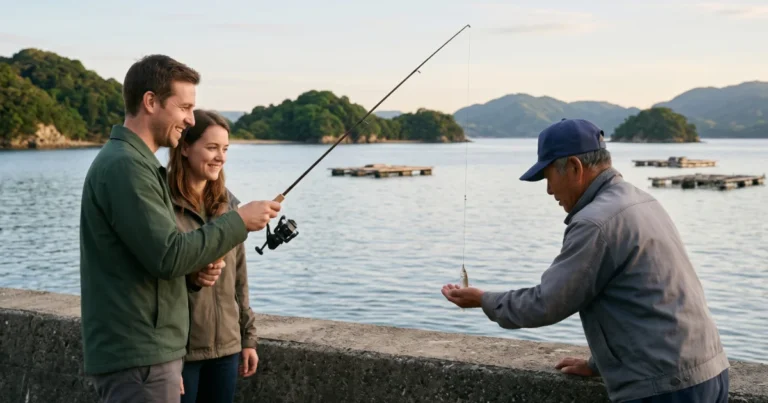
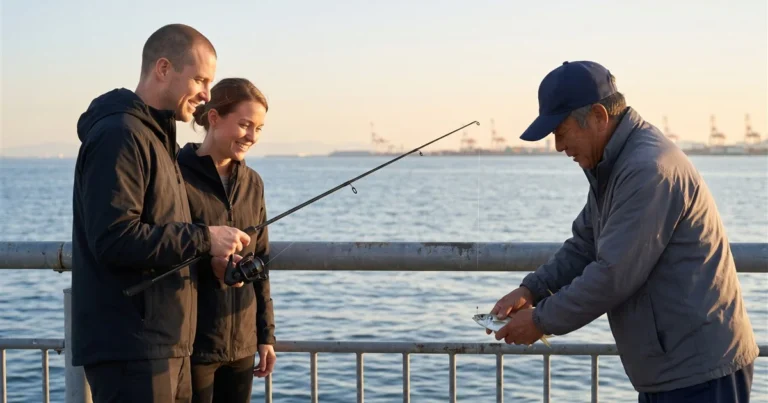
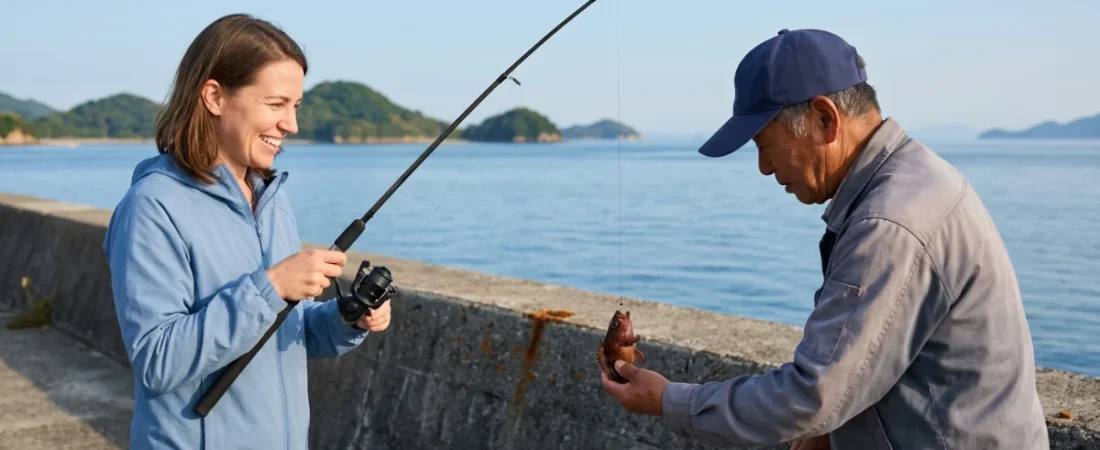
Fishing off a Takamatsu pier before the ferry to Naoshima, or from a rock in Kochi? You don’t need a license for a rod in Shikoku’s sea, but each of the four prefectures has its own rules.
Those rules cover what you can’t take, how small is too small, where you can’t chum, and when you can’t use a light. We cover the sea coasts of Kagawa, Ehime, Tokushima and Kochi. That works whether you’re staying in Takamatsu, Matsuyama, Naruto or Kochi City. Rivers, lakes and dam lakes have their own rules, and they’re in a separate guide.
We built this guide from each prefecture’s regulations, committee instructions and public leaflets, plus the national Fisheries Act. We say so when we couldn’t confirm something. The documents are in Japanese and they change, so call the prefecture or the local fishing co-op if your spot is a close call.
At a Glance
- License: None needed for rod fishing in the sea
- Trolling: Not open to foreign visitors anywhere in Shikoku (national rules)
- Never take: Abalone and sea cucumber, in all four prefectures
- Octopus: Kagawa bans fishing for madako (common octopus) from boats. It allows iidako from boats only in a short autumn window. Tokushima lists octopus as a fishing-rights species on almost all its coast
- Chumming: Banned from boats in Kagawa and Ehime. Ehime also bans it from shore in 17 listed zones
- Lights: Kagawa bans fishing with light on the sea, even light that only reaches the water
- Fines: Up to six months in prison or ¥100,000 (or both) for breaking a prefecture’s size, season or area rules. Up to ¥1,000,000 for taking fishing-rights species. Trolling as a visitor is far heavier: up to three years in prison or ¥30,000,000
Who This Guide Is For
- You plan to fish from a seawall, pier or rocky shore in Kagawa, Ehime, Tokushima or Kochi
- You plan to book a fishing boat or a rock drop-off boat. The boat section tells you what to look for
- You plan to fish inside a facility, such as a raft or a boat operator’s fishing spot. The facility’s own rules apply there. Our Naruto raft fishing guide and Sukumo boat fishing guide cover two of them
- You’re looking for rivers or lakes. We don’t cover freshwater rules here
The national rules differ by coast. The Seto Inland Sea side covers Kagawa, most of Ehime and northern Tokushima. The Pacific side covers southern Tokushima, Kochi and Ehime’s Uwa Sea (宇和海). The red sea bream rule below depends on which side you’re on.
Do You Need a Fishing License in Shikoku?
No, not for rod fishing in the sea. We found no license system for it in official sources. The regulations in all four prefectures list rod fishing and handlines among the methods anyone may use. Our guide to fishing licenses in Japan has the full picture.
On boats, Japan’s Fisheries Agency lets foreign visitors rod-fish from charters run by Japanese fishers. It asks everyone to follow local rules.
Can I fish from the pier while I wait for the Naoshima ferry in Takamatsu?
Not along the quay in front of the ferry and passenger terminals at Sunport Takamatsu. The Takamatsu Port Management Office’s map marks that stretch as a no-fishing zone, for the safety of ships. Elsewhere at Sunport, take your trash and bait home and keep the seawall and walkway clean.
The Rules That Apply Across Shikoku
These four rules hold in every prefecture we cover, or close to it.
Rod and handline are fine everywhere
All four prefectures list rod fishing and handlines as methods an angler may use at sea. Kagawa and Ehime add one exception: chumming from a boat. Kagawa also rules out fishing for madako (common octopus) from a boat. Both are covered in the next sections.
Anything outside each prefecture’s list is off-limits. Snagging, where you drag a bare hook to catch a fish by its body, is the usual example. Kagawa and Ehime say plainly that snagging is banned.
Trolling isn’t open to visitors
Trolling means dragging lines behind a moving boat. Japan’s national rules let foreign visitors troll only in three listed areas: off Shimoda in Izu, off Lake Hamana, and around Yonaguni Island. None is in Shikoku. That includes trolling from a charter boat.
Japanese nationals and permanent residents follow each prefecture’s own list, which doesn’t include trolling either.
Never take abalone or sea cucumber
Anglers can’t take abalone or sea cucumber, whatever the size or season. It’s a national rule, and all four prefectures repeat it. Kagawa says even a small catch for your own dinner can bring charges.
Shellfish, sea urchins, seaweed and spiny lobster belong to local fishers
Local fishing co-ops hold the rights to many sea animals and plants. Taking them can bring a fishing-rights charge. The species differ by prefecture, so we don’t treat the four as one:
- Kagawa: sea cucumber, abalone, turban shells (sazae), sea urchins and wakame seaweed. Octopus isn’t on its list
- Tokushima: octopus, tokobushi (a small abalone relative), turban shells and spiny lobster
- Kochi: abalone, tokobushi, turban shells and spiny lobster
- Ehime: abalone, turban shells, wakame and octopus in the prefecture’s examples. Octopus is listed in most of its coastal rights, and spiny lobster in most of the southern Uwa Sea
What Each Prefecture Allows: Quick Tables
Use these four tables to compare the rules that trip up visitors most. “No ban found” means we found no prohibition in the regulation. It doesn’t mean the activity is allowed everywhere.
Kagawa
| Topic | Answer | Where it comes from |
|---|---|---|
| Trolling | No for visitors (national rule). The prefecture also bans it | Regulation, prefecture page |
| Chumming from a boat | No | Regulation |
| Chumming from shore | No ban found | Regulation |
| Lights for rod fishing | No. Fishing with light on the sea is banned, even light that only reaches the water | Regulation, “Umi no Techo 2026” booklet |
| Snagging | No, from shore too | Prefecture page |
| Abalone and sea cucumber | No | National Fisheries Act |
| Octopus | From boats: no madako. Iidako only September 1 to October 15, before noon | Regulation, committee instruction |
Ehime
| Topic | Answer | Where it comes from |
|---|---|---|
| Trolling | No for visitors (national rule). The prefecture also bans it | Regulation, leaflet |
| Chumming from a boat | No | Regulation, leaflet |
| Chumming from shore | No in 17 listed zones, unless the rights holders agree. Red clay chum is banned everywhere | Committee instruction |
| Lights for rod fishing | No ban found. Lights are banned for hand nets and spears | Regulation |
| Snagging | No | Leaflet |
| Abalone and sea cucumber | No | National Fisheries Act |
| Octopus | Off-limits where fishing rights cover it, which is most of the coast | Prefecture fishing-ground plan |
Tokushima
| Topic | Answer | Where it comes from |
|---|---|---|
| Trolling | No for visitors (national rule). The prefecture also says it can’t be done | Regulation, prefecture page |
| Chumming from a boat | No ban found | Regulation |
| Chumming from shore | No ban found | Regulation |
| Lights for rod fishing | No ban found. Lights are banned for hand nets and spears | Regulation |
| Snagging | The regulation doesn’t name it. We couldn’t confirm | Regulation |
| Abalone and sea cucumber | No | National Fisheries Act |
| Octopus | Off-limits in fishing-rights areas, which cover almost the whole coast | Prefecture fishing-rights list |
Kochi
| Topic | Answer | Where it comes from |
|---|---|---|
| Trolling | No for visitors (national rule). It isn’t on the prefecture’s list of angler methods | Regulation |
| Chumming from a boat | No ban found | Regulation |
| Chumming from shore | No ban found | Regulation |
| Lights for rod fishing | No ban found. Lights are banned for hand nets and spears. Oil-soaked bait is banned | Regulation |
| Snagging | The regulation doesn’t name it. We couldn’t confirm | Regulation |
| Abalone and sea cucumber | No | National Fisheries Act |
| Octopus | Not in the 2023 fishing-ground plan for first-class rights. No size limit | Prefecture fishing-ground plan |
Source: Kagawa, Ehime, Tokushima and Kochi fisheries regulations and committee instructions, checked November 2026.
Releasing non-native freshwater fish is a river and lake matter. Our Shikoku river and lake guide covers it once it’s published.
Octopus: Where You Can and Can’t Fish for It
Octopus is the question visitors ask most. The answer changes by prefecture, and in Kagawa it changes by month.
Kagawa
You can’t fish for madako, the common octopus, from a boat at any time. If one takes your hook, the prefecture says to release it without bringing it aboard. Kagawa’s list of fishing-rights species has no octopus, but boats have their own rule.
Small iidako (a small octopus) are the exception. The committee’s instruction allows boat fishing for iidako only in a short window. Iidako catches have fallen sharply: six local co-ops landed 199.3 tons in 2002 and 4.2 tons in 2025.
September 1 – October 15
Open window
You may fish for iidako from a boat
0:00–12:00
Morning only
Be off the water by noon
August 1–31, 2026 and October 16, 2026 – July 31, 2027
Closed
No iidako fishing from a boat, all day
Until July 31, 2027
Instruction ends
We couldn’t confirm what comes after
Source: Kagawa Sea Area Fisheries Adjustment Committee Instruction No. 6 (2026), via Kagawa Prefecture, checked November 2026.
Kagawa also asks anglers, as a favor, to release small iidako and to avoid spots crowded with octopus-pot lines.
Kagawa’s flyer just says iidako fishing is September 1 to October 15. Does that mean I can’t fish for iidako from the shore?
The flyer and the booklet are worded for everyone, but we found no instruction that limits shore fishing. The flyer still asks you to pack up your rod and leave the spot by noon.
Our pick for octopus: plan around Kagawa’s September 1 to October 15 window. It’s the only place in the four prefectures’ documents with exact dates and hours for fishing from a boat. Check the dates again if you’re traveling after July 2027.
Tokushima
The prefecture’s fishing-rights list has octopus in nearly every row, from Naruto to the southern coast. Inside those areas, you can’t take it by any method. Tokushima’s own page says fishing rights cover most of the coast.
Ehime
The prefecture’s fishing-ground plan lists octopus in 117 of 124 first-class fishing rights. That covers most of the coast. Four of the exceptions are in Matsuyama. Where a right covers octopus, you can’t take it, so octopus fishing is out on most of Ehime’s coast.
The plan, published in December 2023, set April 1, 2024 as the planned licensing date. We didn’t check it against the licenses that were issued.
Kochi
Kochi sets no size limit for octopus. Octopus isn’t in the first-class fishing rights in the prefecture’s 2023 fishing-ground plan. That doesn’t mean it’s open everywhere, so ask a local fishing shop or your boat operator.
Size Limits and Closed Seasons
These tables show what anglers can’t take, by prefecture. We left out abalone and sea cucumber, which anglers can never take, and freshwater-only fish. The size and season limits apply to everyone, including where fishing rights don’t apply.
Kagawa
| Catch | You can’t take |
|---|---|
| Blackhead seabream (kurodai) | 6 cm or less in total length, all year |
| Gazami crab | 13 cm or less in carapace width, all year |
| Kuruma prawn | 6 cm or less in body length, all year |
| Asari clams | 2.5 cm or less in shell length, all year |
| Hamaguri clams, 3 cm or less in shell length | All year |
| Hamaguri clams, larger than 3 cm | June 1 to August 31 |
| Eel | 20 cm or less in total length, all year |
| Ayu | January 1 to May 31 |
| Red sea bream (madai), 12 cm or less in total length | July 1 to September 30 (national rule) |
Source: Kagawa fisheries regulation, via Kagawa Prefecture; Seto Inland Sea Fisheries Control Regulation, checked November 2026.
Kagawa sets no size limit for octopus, rockfish (mebaru) or kasago (false kelpfish, a kind of scorpionfish). The prefecture’s booklet suggests release sizes, such as 20 cm or less for red sea bream. Those are requests, not laws.
Ehime
| Catch | You can’t take |
|---|---|
| Kasago and rockfish (mebaru) | 7 cm or less in body length, all year |
| Young buri (Japanese amberjack) | 15 cm or less in total length, all year |
| Turban shell (sazae) | 2 cm or less across the shell’s lid, all year |
| Asari clams | 2 cm or less in shell length, all year |
| Kuruma prawn | 8 cm or less in body length, all year |
| Hamaguri clams, 4 cm or less | All year |
| Hamaguri clams, larger than 4 cm | May 1 to September 30 |
| Japanese spiny lobster, 15 cm or less | All year |
| Japanese spiny lobster, larger than 15 cm | June 1 to August 31 |
| Barred knifejaw (ishidai) | 9 cm or less in body length, July 1 to October 31 |
| Red sea bream, Uwa Sea (宇和海), 9 cm or less in body length | July 1 to September 30 |
| Red sea bream, Seto Inland Sea side, 12 cm or less in total length | July 1 to September 30 (national rule) |
| Eel, 25 cm or less | All year |
| Eel, larger than 25 cm | October 1 to March 31 |
| Ayu | January 1 to May 31 |
Source: Ehime fisheries regulation, committee instruction and the prefecture’s leaflet “Rules and manners for anglers” (in Japanese), via Ehime Prefecture, checked November 2026.
Ehime’s eel rule runs until March 2027. Ehime’s leaflet gives a handy size guide: a ¥1 coin is exactly 2 cm across. Ehime also asks you not to fish for sawara (Spanish mackerel) while the local drift-net closed season runs, as a favor to fishers. That request isn’t a law.
Tokushima
| Catch | You can’t take |
|---|---|
| Japanese spiny lobster, 13 cm or less | All year |
| Japanese spiny lobster, larger than 13 cm | May 15 to September 15 |
| Tokobushi, 3 cm or less | All year |
| Tokobushi, larger than 3 cm | August 20 to November 30 |
| Hamaguri clams, 3 cm or less | All year |
| Hamaguri clams, larger than 3 cm | May 1 to November 30 |
| Bakagai (a clam) | May 1 to November 30 |
| Young buri (Japanese amberjack) | 15 cm or less in total length |
| Eel, 20 cm or less | All year |
| Eel, larger than 20 cm | November 1, 2026 to March 31, 2027 |
| Ayu | December 1 to May 31 |
| Red sea bream (madai), 12 cm or less in total length | July 1 to September 30, northern Seto Inland Sea waters only (national rule) |
Source: Tokushima fisheries regulation and committee instruction, via Tokushima Prefecture, checked November 2026.
In Tokushima, Naruto, Tokushima City, 小松島 and northern 阿南 are on the Seto Inland Sea side. 美波, 牟岐 and 海陽 are on the Pacific side.
Kochi
| Catch | You can’t take |
|---|---|
| Japanese spiny lobster, 13 cm or less in body length | All year |
| Japanese spiny lobster, larger than 13 cm | May 1 to September 15 |
| Turban shell (sazae) | September 1 to March 31 |
| Tokobushi, 3 cm or less | All year |
| Tokobushi, larger than 3 cm | September 1 to March 31 |
| Young buri (Japanese amberjack) | 15 cm or less in total length, all year |
| Eel, 21 cm or less | All year |
| Eel, larger than 21 cm | October 1 to March 31 |
| Ayu | December 31 to May 15 |
Source: Kochi fisheries regulation and committee instruction, via Kochi Prefecture, checked November 2026.
Kochi’s eel rule also runs until March 2027. Kochi sets no size limit for octopus or red sea bream. The Seto Inland Sea rule doesn’t reach Kochi’s Pacific coast.
Spiny lobster isn’t a seasonal catch for visitors
The tables show size and season limits that apply to everyone. In Tokushima and Kochi, though, spiny lobster is also a fishing-rights species along most of the coast. There you can’t take it at any size or time of year.
In Kochi’s fishing-ground plan, spiny lobster is covered in 86 of 97 first-class rights. The exceptions are mostly sandy coast along Tosa Bay and the inner Uranouchi Bay (浦ノ内湾). In Ehime, it’s covered in 39 of 41 first-class rights in the Uwa Sea. It’s in 8 of 35 in the Iyo Sea (伊予灘) and none of 48 in the Hiuchi Sea (燧灘).
Tokushima’s size limits start at 13 cm, Ehime’s at 15 cm. Don’t read a 13 cm or 15 cm lobster in an open season as legal to keep. We’d treat spiny lobster as off-limits in Tokushima, Kochi and Ehime’s Uwa Sea, because fishing rights cover most of those coasts.
Chumming, Lights and Oil Bait
Chumming means scattering bait to draw fish in. Lights draw fish and squid at night. Shikoku’s rules on both differ a lot by prefecture.
- Kagawa: Chumming from a boat is banned. We found no ban on chumming from shore. Using light on the sea to fish is banned across the prefecture’s waters, even light that only reaches the water. We couldn’t find electric floats named either way, so we’d skip night fishing with a lamp in Kagawa
- Ehime: Chumming from a boat is banned. Chumming from shore is banned in 17 listed zones, and red clay chum is banned across the whole sea. Oil-soaked squid (aburaika) fishing is banned too
- Tokushima and Kochi: We found no ban on chumming from boats or shore, and no ban on lights for rod fishing. That means “no ban found”, not “allowed”. Boat operators know their area, so ask yours
- Kochi: Oil-soaked bait is banned, including oil-soaked squid (kusaika) and imitation bait that uses oily material
Ehime’s 17 no-chum zones (from shore)
Ehime’s committee instruction bans chumming from the shore, seawalls and piers in these zones. It includes chum baskets (komase) and dumpling bait (dango). It’s valid until March 31, 2028. You can chum in a zone if the rights holders agree.
This table shows the area each zone covers, in the prefecture’s own list.
| Place | Area covered |
|---|---|
| Imabari, the island 小島 (4 zones) | 150 m radius around each of 4 listed points |
| Imabari, 波方町, 大角鼻 | 150 m radius |
| 上島町, 岩城, 孤隠崎 | 100 m radius |
| Imabari, Umashima (馬島, 4 zones) | Named points, shown in the answer below |
| Imabari, 吉海町, 中渡島 | 200 m radius |
| Imabari, 関前, 小大下島 明神 | A stretch of coast, 400–450 m out to sea |
| Imabari, 波方町, 馬刀潟 | 200 m radius |
| 伊予市, 森 | A stretch of coast, 180–200 m out to sea |
| 伊方町, tip of the Sadamisaki Peninsula (佐田岬, 2 zones) | Up to 1,000–1,500 m out to sea |
| 宇和島市, 御五神島 | The waters around the island, 1,000–1,200 m out |
Source: Ehime Prefecture, committee instruction No. 146 and the list of no-chum zones, via Ehime Prefecture, checked November 2026.
The prefecture’s map is too rough to place each point. Only the fisheries division or the local co-op can tell you whether your spot is inside a zone. We can’t say. Red clay chum is banned everywhere, with or without a zone.
I’m cycling the Shimanami Kaido and staying in Imabari. Can I use a chum basket on Umashima?
Umashima isn’t a whole-island ban. The list names five points in four zones, and each point has a 150 m radius: a marker at 水揚磯, and the capes 渦ノ鼻, 小浦崎, 洲ノ崎 and ナガセ鼻. 水揚磯 and ナガセ鼻 share a zone. Imabari port itself (今治港) isn’t on the list.
If you fish around the Imabari islands, we’d leave the chum basket at home unless you’ve confirmed your spot.
Prefecture by Prefecture
Some rules apply to one place only. Use this section to match your spot to its local rules.
Kagawa
- No-take waters: Taking anything is banned in five sea areas. They’re waters west of 伊吹島, east of 股島, north of 粟島, north of 乃生 in Sakaide, and west of 向島 in Naoshima town
- Megijima and Ogijima: No protected waters or ban areas apply there. The Megijima and Ogijima islands, and Naoshima, have fishing rights held by local co-ops
- Ports: The restricted quays at Takamatsu and Sakaide are in the ports section below
Ehime
- Futagami Island (二神島): The waters off the island are protected, and you can’t take any sea animal or plant
- Precious coral: Taking precious coral in the southern sea area is banned until March 31, 2027
- Southern sea area (宇和海): Ehime marks it as the sea south of a line from Sadamisaki to Sekizaki lighthouse in Oita
Tokushima
- Naruto tsukiiso reefs: A tsukiiso is an artificial fish reef on the seabed. Only fishers may work these reefs, and that includes fishing with a rod. The ban covers a 200 m radius around each reef, and there are 13. The prefecture’s Naruto page has a table with each reef’s center coordinates, so we’d check it before you fish the Naruto coast. Don’t take wakame or octopus inside the area
- Aquaculture and nets: The prefecture asks you not to fish around wakame farming racks and oyster rafts. Never cross in front of working fishing boats or anchor near them
- Spears and hooks: In fishing-rights waters, taking fish with yasu spears or hagu hook gear is banned (rakes and trowels excepted). The instruction ends December 31, 2026. We couldn’t confirm what replaces it
- Naruto rafts: Our Naruto raft fishing guide covers that facility’s own rules
Kochi
- Sea turtles: Taking sea turtles is banned. Instruction No. 101 runs until December 31, 2026, and No. 108 replaces it from January 1, 2027 to December 31, 2029
- Set nets: Don’t tie your boat to a set net’s gear, and don’t use it to hold your boat while you fish (Instruction No. 100, valid to August 2028, while the net is set)
- Ashizuri Cape: Acts that disturb the buri feeding grounds off Shirayama are banned within 800 m (Instruction No. 99)
- Bays: Taking asari clams is banned in two zones of Uranouchi Bay (浦ノ内湾) until March 31, 2027. Around Nomi Bay (野見湾) and Susaki Bay (須崎湾), taking two kinds of shellfish (chanbara and chōtarō) is banned in set zones until August 31, 2027. Research and the committee’s special approval are the exceptions
Okinoshima and Ugurushima
Instruction No. 105 covers the waters within 1,000 m of the shoreline around eight islands off Sukumo, including Okinoshima and Ugurushima. It’s valid until December 31, 2029. Fishing for isaki (chicken grunt) from a boat there needs the committee’s approval for each boat. The conditions include no fishing or anchoring from one hour after sunset to one hour before sunrise. They also bar isaki under 19 cm in fork length. Our Sukumo boat fishing guide covers the area.
Can I rent a small boat and fish for isaki around Okinoshima?
Approval goes to fishing co-op members using fishing boats under 5 tons. The instruction doesn’t say how it treats charter-boat guests, so ask the boat you book.
Pacific Bluefin Tuna
Tokushima and Kochi both explain bluefin in their own material. Kagawa only points to the Fisheries Agency’s bluefin page, and Ehime only asks anglers for cooperation.
- Tokushima: Release any bluefin under 30 kg at once if you hook one. For fish of 30 kg or more, each person may keep one per period and must report within one day of landing. Since April 1, 2026, anglers must also notify the Fisheries Agency at least one business day before fishing for bluefin of 30 kg or more. Charter operators file their own notice
- Kochi: Bluefin under 30 kg are banned all year. For fish of 30 kg or more, each person may keep one per two months and must report by the day after landing. Taking can also be banned once a yearly catch cap (60 tons) is reached
If you want to fish for bluefin in Tokushima, file your own notice with the Fisheries Agency at least one business day before, and book a boat that has filed its operator notice. Ask the boat before you book.
Fishing Boats and Ports
Booking a boat
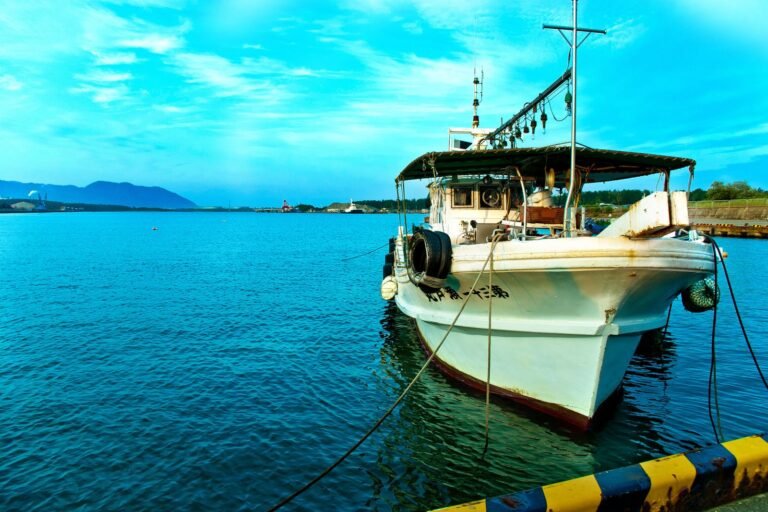
A fishing boat that takes paying passengers must be registered with the governor. All four prefectures say so. Rock drop-off boats (sewatashi, 瀬渡し), breakwater drop-offs and raft drop-offs count too, according to Kagawa and Tokushima. Tokushima adds raft drop-offs.
Each prefecture lists duties for operators or checks for passengers:
- Kagawa: Operators must tell passengers the fishing-ground rules, keep a passenger list, and carry insurance of at least ¥50 million per passenger
- Ehime: Wear a life jacket anywhere outside the cabin, and on the rocks too. Check how you’d call for help in an emergency on the rocks
- Tokushima: Operators show a registration number on the hull and a registration certificate, with insurance of at least ¥50 million per passenger
- Kochi: Check that the boat shows its registration certificate, that your day is inside the insurance period, and that you sign the passenger list. The prefecture’s list of registered operators, dated February 28, 2026, is on its site
On small boats in Japan, the captain must make everyone outside the cabin wear an approved life jacket. That’s a national rule from the transport ministry, and fishing is not an exception. Don’t chum from a boat in Kagawa or Ehime.
How can I tell a boat in Shikoku is registered?
Kagawa boats show a mark in the form 釣 香川県第〇〇号, with a registration certificate on the boat and at the office.
We’d pick a boat that shows its number on the hull. If an operator doesn’t, ask before you pay.
Ports and seawalls
We found no list of no-fishing ports from any of the four prefectures. Follow the signs and fences at each port, and look for signs reading 釣り禁止 (no fishing) or 立入禁止 (no entry). Tokushima says fishing in ports is generally free, but don’t enter areas with keep-out signs or fences.
- Kagawa: Port security zones (SOLAS) at Takamatsu Port (朝日 and 玉藻 districts) and Sakaide Port (中央埠頭, 西埠頭, 林田 and 番の州 districts) are off-limits. The prefecture says you can’t enter the quays in these zones to fish, and you can’t enter the waters by boat either. We didn’t check the zone boundaries on a map, so look for keep-out signs and fences, or call the port divisions below. The breakwater with the red lighthouse (玉藻防波堤) closes its gate in advisories and warnings, and its boardwalk is being repaired in stages (July 2026 notice)
- Ehime: The international quays at 三島川之江港, 東予港, Matsuyama Port and 宇和島港 have restricted zones
- Kochi: The working-yard quay at 室津港 in 室戸 is normally closed to the public, according to a 2020 port document. The national government named Kochi Port a “model port for fishing culture” in 2019. We couldn’t confirm that any area has been opened to anglers
⚠️ Fishing gear and farming racks — Kagawa, Ehime and Tokushima ask you not to fish around nets or racks
- Port entrances — Ehime asks you not to fish at port entrances or other dangerous spots
- Set nets — In Kochi, don’t tie a boat to a set net
- Working boats — In Tokushima, never cross in front of a working fishing boat
Penalties
This table shows maximum penalties, not typical ones. Some prefecture pages still use older wording and old Fisheries Act article numbers. We give the amounts under the current Fisheries Act on e-Gov (in Japanese).
| What you did | Maximum penalty |
|---|---|
| Broke a prefecture sea rule (closed season, size limit, banned area) | Up to six months in prison or a fine of up to ¥100,000, or both |
| Used a method anglers can’t use, such as boat chumming in Kagawa or Ehime | A minor fine (karyō, 科料) |
| Trolling as a foreign visitor outside the areas and periods the government lists | Up to three years in prison or a fine of up to ¥30,000,000, or both |
| Took a species covered by fishing rights (octopus, spiny lobster) | Fine of up to ¥1,000,000 under the Fisheries Act. Prosecution needs a complaint from the rights holder |
| Took abalone or sea cucumber | Up to three years in prison or a fine of up to ¥30,000,000 under the Fisheries Act |
| Took a Seto Inland Sea red sea bream of 12 cm or less in July to September | Up to two years in prison or a fine of up to ¥500,000, or both |
| Ignored the governor’s order to obey a committee instruction (such as a chum ban) | Up to one year in prison or a fine of up to ¥500,000, or detention or a minor fine |
Source: Kagawa, Ehime, Tokushima and Kochi fisheries regulations, the Seto Inland Sea Fisheries Control Regulation (e-Gov, in Japanese) the Fisheries Act and the Act on the Regulation of Fishing Operations by Foreign Nationals, checked November 2026.
After a breach of a prefecture rule, your catch and gear can also be confiscated. A committee instruction has no direct penalty. The penalty applies when you ignore the governor’s order to follow it.
Who to Ask (and English Support)
We couldn’t find an English contact for fishing rules in any of the four prefectures. We’d have a Japanese speaker or a translation app ready when you call.
- Kagawa Prefecture, Fisheries Division: 087-832-3473 / +81-87-832-3473. The sea committee office is 087-832-3477 / +81-87-832-3477
- Takamatsu Port Management Office (Kagawa): 087-851-3442 / +81-87-851-3442
- Kagawa Port Division (security zones, Takamatsu Port): 087-832-3548 / +81-87-832-3548
- Sakaide City Port Division (Sakaide Port): 0877-44-5010 / +81-877-44-5010
- Ehime Prefecture, Fisheries Division: 089-912-2620 / +81-89-912-2620
- Tokushima Prefecture, Fisheries Management Division: 088-621-2476 / +81-88-621-2476. For ports: 088-621-2589 / +81-88-621-2589
- Kochi Prefecture, Fisheries Management Division: 088-821-4608 / +81-88-821-4608
- Sea emergency: 118. The Takamatsu Coast Guard office is 087-821-7011 / +81-87-821-7011
To call from your phone, you’ll need data or a Japanese SIM. Our eSIM guide for fishing in Japan has options.
FAQ
QDo I need a fishing license in Shikoku?
No, not for rod fishing in the sea. Our license guide explains more.
QCan I troll in Shikoku?
No. Foreign visitors can troll only in three listed areas, and none is in Shikoku.
QWhen can I fish for iidako in Kagawa?
From a boat, only September 1 to October 15, from midnight to noon, until July 2027.
QCan I chum from a pier in Ehime?
Not in the 17 listed zones, unless the rights holders agree. Red clay chum is banned everywhere.
QCan I take spiny lobster in Kochi or Tokushima?
No, not along most of their coasts. It’s a fishing-rights species there, and size and season limits also apply.
QCan I fish at night with a light in Kagawa?
No. Kagawa bans using light on the sea to fish, even light that only reaches the water.
QCan I fish on a tsukiiso reef in Naruto?
No. Only fishers can work these reefs.
QWhat happens if I break a rule?
Breaking a prefecture’s size, season or area rules carries up to six months in prison or a ¥100,000 fine. Taking a fishing-rights species can bring up to ¥1,000,000. Trolling by a foreign visitor can bring up to three years in prison or ¥30,000,000.
Ready to Book?
Know the rules first, and the only thing that should slip off your hook is a small fish.
If you’re staying in Takamatsu, Matsuyama, Naruto or Kochi City and want a day on the water, these three checks cover most of the trouble.
Check the prefecture
Match your spot to Kagawa, Ehime, Tokushima or Kochi before you read its rules.
Check the zone before you chum
In Ehime, 17 shore zones are off-limits unless the rights holders agree.
Check the boat
Look for its registration number on the hull.
Looking for a place to start? These guides cover specific spots:
- Naruto raft fishing guide
- Sukumo boat fishing guide
- Fishing techniques and tackle in the Seto Inland Sea