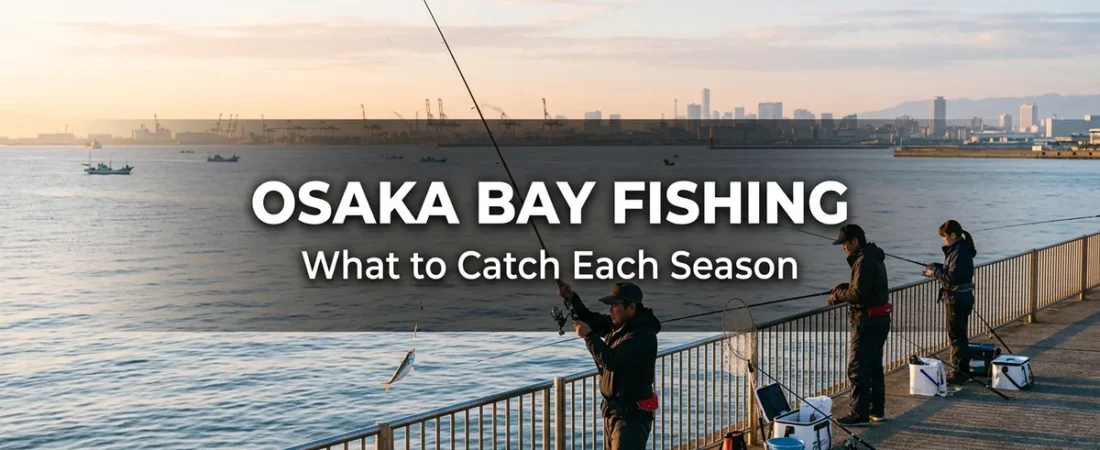
Osaka Bay is a sea you can reach by train from central Osaka. What you catch changes a lot with the season: rockfish and scorpionfish in spring, horse mackerel and sardines on sabiki rigs in summer, hairtail and young yellowtail in autumn, and flounder and greenling in winter.
This guide is based on the official monthly catch calendars of three fishing parks on Osaka Bay: Nanko Fishing Park, Amagasaki City Fishing Park, and Totto Park Koshima. Two of them rent rods, so you can go fishing in Osaka even if you didn’t bring any gear.
What you catch depends on water temperature, tides, and where the schools are that year. The months in this guide come from each park’s own calendar. They are a guide, not a promise of a catch.
Quick answer:
- Most fish species: Summer to autumn has the most fish species in Osaka Bay.
- For beginners: Late spring to early autumn, with a rental rod and a sabiki rig at Nanko or Amagasaki.
- For bigger fish: Totto Park Koshima, near Kansai Airport, if you bring your own gear.
Osaka Bay Fishing Seasons at a Glance
| Season | Main fish | Main methods |
|---|---|---|
| Spring (Mar–May) | Rockfish, scorpionfish, fat greenling, black sea bream, Japanese sea bass, red sea bream (Apr–May), golden cuttlefish (Apr–May) | Float fishing with live shrimp, probing along the wall, basket float fishing, eging |
| Summer (Jun–Aug) | Horse mackerel, sardines, mackerel, sardinella, halfbeak, octopus, hairtail (from August) | Sabiki fishing, octopus fishing |
| Autumn (Sep–Nov) | Hairtail, horse mackerel, sardines, mackerel, young yellowtail (hamachi, mejiro), bigfin reef squid, red sea bream, filefish | Sabiki fishing, live-bait fishing, lure fishing, eging |
| Winter (Dec–Feb) | Rockfish, scorpionfish, flounder, fat greenling, black scraper, Japanese sea bass, black sea bream | Float fishing, probing along the wall, bottom fishing |
Put the three parks’ calendars together and summer to autumn has the most species. Totto Park lists the most in autumn, and Nanko lists the most in summer. Amagasaki City Fishing Park says on its official site that late spring to early autumn is the season when even beginners catch fish relatively easily.
What You Can Catch in Osaka Bay by Season
Spring (March–May): rock-dwelling fish and the first big fish
- Totto Park Koshima:
- Rockfish (mebaru) and marbled flounder (makogarei) until May, and scorpionfish (kasago) until April.
- Red sea bream (madai) and olive flounder (hirame) from April.
- Amagasaki City Fishing Park: Fat greenling (ainame) until May and surfperch (umitanago) from March to May.
- Nanko Fishing Park: Yellowtail and golden cuttlefish (kouika) from April. Horse mackerel and sardines on sabiki rigs from May.
- All three parks: Black sea bream (kurodai) and Japanese sea bass (suzuki) are on the calendar year-round.
Spring isn’t yet the season for catching lots of fish on a sabiki rig. For horse mackerel, the calendars point to May at Nanko and April at Totto Park.
Summer (June–August): sabiki season
- Nanko and Amagasaki: Horse mackerel (aji), sardines (iwashi), and mackerel (saba) on sabiki rigs. Amagasaki also lists Japanese sardinella (sappa) and halfbeak (sayori).
- Octopus: June–August at Nanko, and June–September at Totto Park.
- Amagasaki: Japanese flying squid (surume-ika) from June to August.
- Totto Park: Barred knifejaw (ishidai) and thread-sail filefish (kawahagi) in July and August.
- Hairtail (tachiuo): From August at Nanko and Totto Park.
The parks open early in summer. Nanko opens at 5:00 from April to November, and Amagasaki opens at 5:00 from July to October. Fish in the morning, before the heat builds.
Autumn (September–November): hairtail and big fish
- Hairtail: On the calendar at all three parks (Nanko Aug–Nov, Amagasaki Sep–Nov, Totto Park Aug–Nov).
- Young yellowtail:
- At Totto Park, hamachi (Sep–Dec) and mejiro (Aug–Dec). These are names for yellowtail at different sizes.
- At Nanko, yellowtail (Sep–Nov).
- Bigfin reef squid (aori-ika): Totto Park (Aug–Nov).
- Sabiki fishing: Horse mackerel, sardines, and mackerel keep biting at Nanko and Amagasaki.
- Totto Park Koshima: Red sea bream and filefish. From November, rockfish, scorpionfish, and marbled flounder come back.
Winter (December–February): rock-dwelling fish and flounder
- Totto Park Koshima: Rockfish, scorpionfish, marbled flounder, horse mackerel, and octopus (Dec–Jan).
- Amagasaki City Fishing Park: Fat greenling, flounder (karei), and black scraper (umazura-hagi).
- Nanko Fishing Park: Scorpionfish, largescale blackfish (gure), sea bass, and black sea bream. These four are the only fish on Nanko’s calendar in winter.
All three parks close early in winter: Nanko and Amagasaki at 17:00, and Totto Park at 18:00. Night fishing isn’t possible at the fishing parks.
Fishing Methods Used in Osaka Bay
The months below follow the three fishing parks’ official calendars.
Sabiki fishing (horse mackerel, sardines, mackerel, sardinella)
A sabiki rig has a row of small hooks dressed with tiny lures. You attach a small basket filled with chum (tiny krill called ami-ebi) to draw in a school of fish. When a school arrives, you can catch several fish at once.
- Horse mackerel season: May–November at Nanko, June–November at Amagasaki, and April–February at Totto Park.
- Rental rods:
- At Nanko, a rental rod (¥1,000) comes with a sabiki rig.
- Amagasaki also rents rods with a rig (¥1,500). Ask on site which rig is included.
Float fishing with live shrimp (sea bass, rockfish, greenling, black sea bream)
A live shrimp is hooked and drifted under a float at the depth you want to fish. In the Kansai region, tackle shops sell these shrimp as shirasa-ebi. Scattering live shrimp as chum while you fish is called ebi-maki fishing.
- The shop at Amagasaki City Fishing Park sells shirasa-ebi, though it can sell out.
- The park held a sea bass ebi-maki tournament in February–March 2026.
Probing along the wall (scorpionfish, rockfish, greenling)
You drop a weight to the bottom and slowly work it along the seawall and into gaps between rocks. This is the way to target fish that live among rocks.
- Scorpionfish: Year-round at Nanko, November–April at Totto Park.
- Rockfish: November–May at Totto Park.
- Fat greenling: December–May at Amagasaki.
Otoshikomi: dropping bait along the wall (black sea bream)
You let a bait sink slowly right next to the seawall. Black sea bream is on the calendar year-round at all three parks.
- At Totto Park, kishu-zuri and dango fishing (methods that use rice bran or sand balls as chum) are not allowed.
Live-bait fishing, called nomase (young yellowtail, olive flounder, sea bass)
You hook a small live horse mackerel, often one you caught on a sabiki rig, and let it swim to attract a bigger predator.
- Totto Park: Hamachi (Sep–Dec), mejiro (Aug–Dec), and olive flounder (Apr–Jun and Nov–Dec).
- Nanko: Yellowtail (Apr–May and Sep–Nov).
Basket float fishing, called kago-zuri (red sea bream, other fish)
A basket of krill hangs below a float and drifts out with the current.
- Red sea bream at Totto Park: April–June and September–December.
- Long casting: Each park has its own rules on casting far, so ask the park whether basket float fishing is allowed.
Hairtail fishing (float fishing and lures)
Hairtail becomes active from evening into the night. Anglers target it with a float rig baited with fish strips, or with lures.
- Season: August–November at Nanko, September–November at Amagasaki, and August–November at Totto Park.
- Closing time: The fishing parks close at night, so your best window is the evening before closing:
- Nanko closes at 19:00 (April–November).
- Amagasaki closes at 20:00 (July–October).
- Totto Park closes at 20:00 (March–November).
Lure fishing (young yellowtail, hairtail, sea bass)
You cast a metal jig or another lure and reel it in so it looks like a swimming baitfish. Each park has its own rules on lures:
- Nanko: The official site says lures are OK.
- Amagasaki: The rules say “dangerous casting and lure fishing are prohibited.”
- Totto Park: The rules don’t mention lures, so ask the park.
Eging (bigfin reef squid, golden cuttlefish)
An egi is a shrimp-shaped lure for squid. Follow each park’s lure rules above.
- Bigfin reef squid: August–November at Totto Park.
- Golden cuttlefish: April–June at Nanko.
- Awaji Island: Anglers on the Awaji Island coast are asked to release bigfin reef squid. The request covers squid with a mantle under 15 cm all year, and all sizes from July 1 to September 30.
Octopus fishing
You drop an octopus rig to the bottom and work it along the base of the seawall.
- Nanko: June–August.
- Totto Park: June–September and December–January.
- At a fishing park: If you have any questions, call the park.
Bottom fishing (flounder)
You leave the bait on the bottom and wait for a bite.
- Season: December–February at Amagasaki, and November–May at Totto Park (marbled flounder).
- Long casting: Casting far is prohibited at Nanko, and Amagasaki prohibits “dangerous casting.”
3 Fishing Parks on Osaka Bay
| Nanko Fishing Park | Amagasaki City Fishing Park | Totto Park Koshima | |
|---|---|---|---|
| Location | Suminoe Ward, Osaka City | Amagasaki City, Hyogo | Misaki Town, Osaka (about 20 km from Kansai Airport) |
| Fee | Free | Adults ¥830, children ¥410 | Adults ¥1,500, school kids ¥750 (after 15:00: ¥1,000 / ¥500) |
| Rental rods | ¥1,000 (sabiki rig included) | ¥1,500 with rig, ¥1,300 without | None |
| Closed | Wednesdays (open on public holidays) | Tuesdays (open on public holidays; closed the next Wednesday instead) | Fridays (open on public holidays) |
| By train | Bus from Ferry Terminal Station (New Tram), about 10 min | Park shuttle from Hanshin Mukogawa Station (call to request) | Community bus from Nankai Tanagawa Station, about 10 min |
| Lures | Allowed | “Dangerous” lure fishing prohibited | Not mentioned (ask the park) |
| Best for | First-timers with no gear | Anglers who want staff help | Anglers after bigger fish who bring their own gear |
Nanko Fishing Park (南港魚つり園), Osaka City
A free-entry sea fishing park in Nanko, Suminoe Ward, and the easiest of the three to try with no gear: the shop rents rods with a sabiki rig attached for ¥1,000.
- Hours: 5:00–19:00 from April to November, and 7:00–17:00 from December to March.
- Closed: Every Wednesday (open if it’s a public holiday), December 28 to January 4, and in bad weather.
- Getting there: Ferry Terminal Station on the New Tram, then Osaka City Bus route 15 to Nanko-minami 6-chome, about 10 minutes. From late morning, buses run only about once an hour.
👉 For the return bus times, where to fish on the pier, the rules, shop hours and a one-day plan, read our Nanko Fishing Park guide.
Amagasaki City Fishing Park (尼崎市立魚つり公園), Hyogo
From the mouth of the Muko River, a 120 m access bridge leads out to a 200 m fishing pier. Staff work in the management building, and instructors teach fishing techniques.
- Hours:
- 6:00–19:00 in May, June, and November.
- 5:00–20:00 from July to October.
- 7:00–17:00 from December to April.
- Closed: Every Tuesday (open if it’s a public holiday, then closed the next Wednesday), December 31 to January 1, and days with bad weather.
- Fees:
- Adults ¥830, children ¥410 (ages 6 to 15), free under 6.
- Visitors who don’t fish pay ¥200 (adults) or ¥100 (children).
- Children: Kids in 3rd grade or younger must wear a life jacket, which the park lends for free. Children aged 10 and under must be with an adult.
- Reservations: Entry can’t be reserved, and entry may be limited when it’s crowded.
- Official site: https://amagasaki-uoturikouen.com/
Getting there by train: the park shuttle
- Where to board: From Hanshin Mukogawa Station (武庫川), walk along the river toward the sea and go down the stairs to the Hanshin bus rotary. The park’s shuttle is a car marked 武庫川渡船 (Mukogawa Tosen).
- How to call it: The shuttle doesn’t run all the time. Once you reach the rotary, call the park and they’ll send it (+81-6-6417-3000).
- Schedule: Since a notice on August 2, 2026, the shuttle runs once an hour. Pickups are at 15 minutes past each hour, and the first one is at 6:15.
Most travel eSIMs are data-only and can’t make regular phone calls, so plan how you’ll call before you go.
👉 How to choose an eSIM for fishing trips in Japan
Totto Park Koshima (とっとパーク小島), Misaki Town
A paid sea fishing park at the southern tip of Osaka Prefecture, near the border with Wakayama. The name is sometimes spelled “Totto Park Kojima.” Its official monthly calendar lists fish that aren’t on the other two parks’ calendars, such as red sea bream, bigfin reef squid, olive flounder, and barred knifejaw.
- Hours: 6:00–20:00 from March to November, and 7:00–18:00 from December to February.
- Closed: Every Friday (open if it’s a public holiday), and December 31 to January 2.
- Fees:
- All day: adults ¥1,500, elementary and junior high students ¥750.
- Entry after 15:00: adults ¥1,000, students ¥500.
- Preschool children are free, but they fish in the same spot as a paying adult.
- Entry just to watch isn’t allowed.
- Gear: No rental gear, so bring your own rod. The rest house on the pier has a shop selling tackle and bait.
- Life jackets: You must wear a floating vest (life jacket) to enter.
- Rules: Up to two rods per person. Kishu-zuri and dango fishing are not allowed.
- Landing net: The pier stands 2.5–3.5 m above the water, and the park recommends a 5.3–5.4 m landing net.
- Crowded days: Numbered tickets are handed out in the parking lot.
- Octopus: You can catch octopus here. The official calendar lists June–September and December–January.
- Questions: Call the park (+81-72-447-5126).
- Official site: https://minnaga.com/totopark/
Day Plans: Combine Fishing with Osaka Sightseeing
Plan 1: Fish at Nanko, then explore the Tempozan waterfront
In the morning, rent a rod at Nanko Fishing Park and try sabiki fishing. In the afternoon, change from the New Tram to the Chuo Line at Cosmosquare Station and ride to Osakako Station for the Kaiyukan aquarium and the Tempozan waterfront.
How to get to Nanko:
- Take the New Tram to Ferry Terminal Station (フェリーターミナル).
- From the Ferry Terminal Ekimae stop, take Osaka City Bus route 15 to Nanko-minami 6-chome (南港南六丁目), about 10 minutes.
For the return bus times and tips for the day, see our Nanko Fishing Park guide.
The New Tram is an Osaka Metro line, so an Osaka Metro pass covers your train rides from Nanko to Tempozan.
- Osaka Metro Pass: Unlimited rides on all Osaka Metro lines, with an option that adds buses.
👉 Get the Osaka Metro Pass on Klook - Osaka Amazing Pass:
- Unlimited rides on Osaka Metro and Osaka City Buses.
- Free entry to the Santa Maria cruise, the Tempozan Giant Ferris Wheel, and the Captain Line ferry.
- The Kaiyukan aquarium is not included.
👉 Get the Osaka Amazing Pass on Klook
- Kaiyukan aquarium: About a 5-minute walk from Osakako Station.
👉 Book Kaiyukan tickets on Klook
👉 Book Kaiyukan tickets on KKday
Plan 2: Fish at Amagasaki, then visit Koshien
The nearest station to Amagasaki City Fishing Park is Mukogawa on the Hanshin Main Line. Koshien Station is two stops away on the same line, so you can head to Koshien Stadium after fishing.
- Hanshin Railway 1-day passes:
👉 Get the Hanshin 24-Hour Pass + Koshien Museum set on Klook (not available to Japanese passport holders)
👉 Get the Hanshin Railway 1-Day Pass on KKday (also offered with the Kobe Port Liner)
Plan 3: Fish at Totto Park on your first or last day, near Kansai Airport
Totto Park Koshima is about 20 km from Kansai International Airport. There’s no rental gear, so you’ll be carrying your own, and a car makes that much easier. The park has free parking for 100+ cars.
- Rent a car at Kansai Airport:
👉 Compare Kansai Airport rental cars on EconomyBookings
To drive in Japan, you need an International Driving Permit (1949 Geneva Convention) or, for some countries, an official Japanese translation of your license. - By train:
- Take the Nankai Tanagawa Line to Tanagawa Station (多奈川), then the Misaki Town community bus, about 10 minutes.
- A Nankai 2-day pass covers the train, but not the community bus.
👉 Get the Nankai All Line 2-Day Pass on KKday
- Bringing your own rod: Airline rules for rods, hooks, and reel batteries are covered here:
👉 How to bring fishing rods to Japan and get from the airport to your fishing spot
Want to Go Boat Fishing in Osaka Bay?
We couldn’t find any Osaka Bay fishing boat tours on Klook or KKday (as of September 2026). For boat fishing on Osaka Bay, the fishing hotel Awakan in Sumoto, on the east side of Awaji Island, runs boat fishing trips. There are plans for hotel guests and day visitors, and shared trips go out with as few as one person.
👉 Read our full guide to Awakan
👉 Check Awakan on Klook
👉 Check Awakan on KKday
Rules to Know Before You Fish in Osaka Bay
- Fishing license: See our guide.
👉 Do you need a fishing license in Japan? - Bigfin reef squid on Awaji Island: This is a request, not a law. Anglers are asked to release squid with a mantle under 15 cm all year, and all sizes from July 1 to September 30.
- Fishing park rules: Rules on the number of rods, lures, casting, and life jackets differ by park. See each park’s section above.
Checklist Before You Go
- Check the closing day (Nanko: Wednesday, Amagasaki: Tuesday, Totto Park: Friday).
- Parks can close in bad weather. Nanko posts whether it’s open that day on its official Instagram.
- Parks close early in winter (Nanko and Amagasaki at 17:00, Totto Park at 18:00).
- For Totto Park, bring a life jacket and your own rod.
- For Amagasaki by train, make sure you can make a phone call to request the shuttle.
- Nanko doesn’t sell live worms (isome, gokai).
- Take your trash home.
FAQ
What is the best season for fishing in Osaka Bay?
The three parks’ calendars have the most species from summer to autumn. Amagasaki City Fishing Park says late spring to early autumn is when even beginners catch fish relatively easily.
Can I rent fishing gear in Osaka?
Yes, at two of the three parks:
- Nanko Fishing Park rents rods with a sabiki rig for ¥1,000.
- Amagasaki City Fishing Park rents rods for ¥1,500 with a rig or ¥1,300 without.
- Totto Park Koshima doesn’t rent gear.
Can I go night fishing at Osaka Bay’s fishing parks?
No. The parks close in the evening. In summer the latest is 20:00 (Amagasaki from July to October, and Totto Park from March to November).
Can I catch octopus in Osaka Bay?
Yes. Octopus is on the calendar at Nanko (June–August) and Totto Park (June–September and December–January).
Summary
- First time: Start with sabiki fishing in late spring to early autumn at Nanko or Amagasaki, where you can rent a rod.
- Most species: Summer to autumn. In autumn, hairtail is on the calendar at all three parks.
- Bigger fish: Bring your own gear to Totto Park Koshima.
- Octopus: Nanko (June–August) and Totto Park (June–September and December–January).
Official sources (checked September 2026)
- Nanko Fishing Park: https://nankou-uotsuri-en.com/
- Amagasaki City Fishing Park: https://amagasaki-uoturikouen.com/
- Totto Park Koshima (monthly fish calendar): https://minnaga.com/totopark/gyosyu.html
- Ministry of Land, Infrastructure, Transport and Tourism, Kinki Regional Development Bureau (Totto Park Koshima roadside station): https://www.kkr.mlit.go.jp/road/michi_no_eki/contents/osaka/tottopark.html
- Osaka Prefecture, fishing gear and method rules: https://www.pref.osaka.lg.jp/o120130/suisan/ru-ru/seigen.html
- Osaka Prefecture, no-take zone around Kansai Airport: https://www.pref.osaka.lg.jp/o120130/suisan/ru-ru/kuiki.html
- Osaka Prefecture, fishing rights: https://www.pref.osaka.lg.jp/o120130/suisan/gyogyoken/index.html
- Hyogo Prefecture, Awaji Island bigfin reef squid request: https://www.hyogo-suigi.jp/fishing/wp-content/uploads/sites/4/2026/01/20250214_aoriika.pdf
- Osaka Metro 1-day pass: https://subway.osakametro.co.jp/en/guide/page/enjoy-eco.php
- JNTO, driving in Japan: https://www.japan.travel/en/plan/getting-around/cars/