Last checked: October 24, 2026
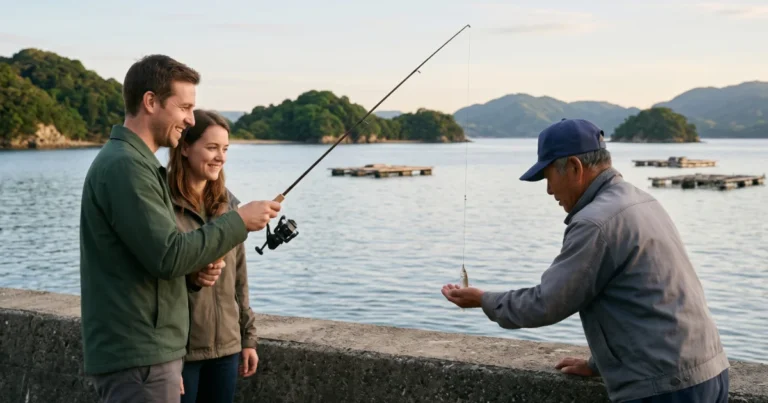
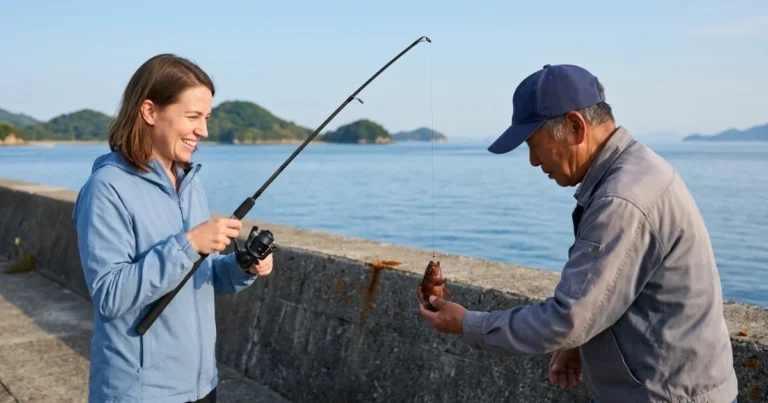
Standing on an Osaka seawall with an octopus on your line, and no idea whether you can keep it? This guide is for that moment.
You don’t need a license to fish the sea in Kansai with a rod. But each prefecture adds its own rules. They cover what you can’t take, how small is too small, where a boat can’t chum and which harbors are off-limits. We cover the sea coasts of Osaka, Hyogo, Kyoto (the Tango coast), Wakayama and Mie (the Kumano-nada coast). That works whether you’re staying in Osaka, Kyoto or Kobe.
We built this guide from each prefecture’s own regulations, leaflets and notices, plus the Fisheries Act. We say so when we couldn’t confirm something. These documents are in Japanese and they change, so check with the prefecture or the local fishing co-op before you fish.
At a Glance
- License: None needed for rod fishing in the sea
- Never take: Abalone and sea cucumber, in all five prefectures
- Octopus: Covered by local fishing rights in all five prefectures. The area differs by prefecture, and Akashi has a winter exception
- Trolling: Not open to foreign visitors anywhere in Kansai (national rules)
- Chumming: Banned from boats across Hyogo. Banned in listed waters in Wakayama and Mie
- Fines: Up to six months in prison or ¥100,000 for most rule breaks. Up to ¥1,000,000 for taking species covered by fishing rights
Who This Guide Is For
- You plan to fish from a seawall, pier or rocky shore in Osaka, Hyogo, Kyoto, Wakayama or Mie
- You plan to book a fishing boat or a rock drop-off boat. The boat section tells you what to look for
- You plan to fish inside a fishing park. The park’s own rules apply there, so read its guide in the links at the end
- You’re looking for rivers or lakes. Nara has no coast, and we don’t cover freshwater rules here. Our Lake Biwa bass guide covers Shiga
For Mie, we cover the Kumano-nada coast, from Toba south.
Do You Need a Fishing License in Kansai?
For rod fishing in the sea, no. Japan has no national license for it. The regulations we read in all five prefectures list rod fishing and handlines among the methods any angler may use. Our guide to fishing licenses in Japan has the full picture.

Do I need a permit to fish from a seawall in Osaka?
Not a fishing permit. But some Osaka Port breakwaters and seawalls are keep-out zones for everyone, rod or no rod. The city decides which ones, and the ports section has the details.
The Rules That Apply Across Kansai
These five rules hold in every prefecture we cover, or close to it.
Rod and handline are fine everywhere
All five prefectures’ regulations list rod fishing and handline fishing as methods an angler may use at sea. Anything outside each list is off-limits for anglers.
Some examples from the prefecture pages:
- Hyogo doesn’t allow fish pots or baskets
- Mie says crab nets don’t count as rod fishing
- Mie also says snagging, where you cast an empty hook to catch a fish by hooking its body, doesn’t count either
Trolling isn’t open to visitors
Trolling means dragging lines behind a moving boat. Japan’s national rules let foreign visitors troll only in a few sea areas and periods set by the government, and none of them is in Kansai. That includes trolling from a charter boat. Our fishing license guide explains the national rules.
Japanese nationals and permanent residents follow each prefecture’s own trolling rules instead.
Never take abalone or sea cucumber
Anglers can’t take abalone or sea cucumber, whatever the size or season. Hyogo’s page adds that if you hook one, you should put it back in the sea.
Shellfish, sea urchins, seaweed and spiny lobster belong to local fishers
Local fishing co-ops hold the rights to many sea animals and plants. Examples on the prefecture pages include Japanese spiny lobster, turban shells (sazae), clams, sea urchins and wakame seaweed. Taking them can bring a fishing-rights charge, even if you only hook them. Wakayama’s leaflet says not to “fish” lobster or octopus inside these areas.
The area these rights cover differs by prefecture. The octopus section shows the differences.
Octopus: Where You Can and Can’t Fish for It
Octopus is the question visitors ask most. In all five prefectures, octopus is covered by local fishing rights. What changes is how much of the coast the rights cover.
| Prefecture | Where octopus is off-limits to anglers |
|---|---|
| Osaka | From Izumisano (泉佐野) south to the Wakayama border, within about 1–2 km of shore |
| Hyogo | Waters under first-class common fishing rights |
| Kyoto | Most sea areas |
| Wakayama | Fishing-rights areas, which the prefecture’s map shows along nearly the whole coast |
| Mie | Most of the coast |
Source: Osaka Prefecture, “Poaching is illegal” and “Fishing rights”; Hyogo Prefecture, local fishing rules; Wakayama Prefecture leaflets; Mie Prefecture, “The use of yasu spears at sea” (checked October 2026); Kyoto Prefecture website: Rules for playing on the rocks, checked October 2026.
Osaka’s page says that south of Izumisano, octopus fishing itself can be punished. The prefecture’s list names no fishing rights north of there. We couldn’t confirm an octopus rule for that stretch either way. Before you keep one, call the Osaka fisheries division (number in the “Who to Ask” section).
I caught an octopus off a pier in Kobe. Can I keep it?
Probably not. Hyogo says fishing rights cover nearly all of its coastline, and octopus is one of the covered species. Kobe isn’t in Akashi, so the winter exception below doesn’t apply there.
Akashi’s winter octopus rules (from December 1, 2026)
Akashi is the exception. Anglers may fish for octopus along Akashi’s coast if they follow these rules. They come from a flyer issued by the Akashi fishery cooperatives federation and posted on Hyogo’s local rules page. The rules apply from December 1, 2026.
Dec 1 – Mar 31
Winter only
Octopus fishing is allowed only in these four months
5:00–12:00
Morning window
Be done by noon
100 g or less
Release it
Small octopus can’t be kept
10 per person
Catch limit
The flyer sets a limit of 10 per person
2 octopus jigs
Gear limit
Octopus jigs are called tako-egi. Hooks must not curve past 180 degrees and must be barbless
Nursery areas
Off-limits
Taking anything is banned in the young-fish nursery area, even for fishers
Source: Akashi fishery cooperatives federation flyer (2026), on the Hyogo Prefecture local rules page, checked October 2026.
The flyer covers fishing boats too. It also asks you not to sell your catch and not to keep small octopus or ones carrying eggs. Breaking the rules counts as poaching and can bring a fishing-rights charge.
We couldn’t confirm what applies before December 1, 2026. By default, the flyer says anglers can’t fish for octopus in these waters. We also couldn’t confirm which piers sit inside the area on the flyer’s map, so check the map before you go.
Our pick for octopus: Akashi, from December to March. It’s the one place in the prefecture documents where anglers are told exactly when and how they can fish for it.
Size Limits and Closed Seasons
Rules you must follow
This table shows fish and shellfish you can’t take, by prefecture. We left out freshwater species and shellfish that fishing rights already cover.
| Where | Catch | You can’t take |
|---|---|---|
| Hyogo, all coasts | Octopus (madako) | 100 g or less |
| Hyogo, Seto Inland Sea side only | Red sea bream (madai) | 12 cm or less in total length, July 1 to September 30 |
| Hyogo, all coasts | Bora (ボラ) | 20 cm or less, April 1 to August 31 |
| Hyogo, Awaji Island coast | Bora (ボラ) | 20 cm or less, April 1 to December 31 |
| Osaka | Bora (ボラ) | 15 cm or less in total length, all year |
| Wakayama | Japanese spiny lobster | 15 cm or less in body length, all year |
| Wakayama | Japanese spiny lobster | Larger ones, May 1 to September 15 |
| Mie | Japanese spiny lobster | 4.2 cm or less in carapace length, all year |
| Mie | Japanese spiny lobster | May 1 to September 30 (north of Toba’s outer islands: to September 15) |
Source: Hyogo Prefecture, fish sizes and seasons; the Seto Inland Sea Fisheries Control Regulation (e-Gov, in Japanese); Osaka, Wakayama and Mie fisheries regulations, checked October 2026.
Three notes on the table:
- The Hyogo sea bream rule is a national Seto Inland Sea rule. It doesn’t cover Hyogo’s Sea of Japan coast
- Wakayama and Mie spiny lobster limits apply even outside fishing-rights areas. Inside those areas, the lobster is off-limits all year anyway
- Kyoto’s regulation sets no size limit for sea fish such as red sea bream, and Osaka’s sets none for red sea bream or octopus
Sizes local fishers ask you to release
These aren’t laws. They’re limits that local fishers set for themselves, and the prefectures ask visitors to follow them. This table shows the length at which you should release the fish.
| Prefecture | Fish | Release if this size or smaller |
|---|---|---|
| Osaka | Red sea bream | 13 cm |
| Osaka | Hirame (ヒラメ) | 28 cm |
| Osaka | Kijihata (キジハタ) | 28 cm |
| Wakayama | Red sea bream | 13 cm in total length |
| Wakayama | Hirame (ヒラメ) | 25 cm in total length |
| Wakayama | Tachiuo (タチウオ) | 45 cm in total length |
| Wakayama | Hamo (ハモ) | 45 cm in total length |
| Wakayama | Isaki (イサキ) | 20 cm in total length |
| Kyoto, eight offshore grounds | Red sea bream | 13 cm in fork length |
Source: Osaka Prefecture, “Let’s return small fish to the sea”; Wakayama Prefecture leaflet; Kyoto’s fishing-ground agreement leaflet, in the Kyoto Prefecture website’s leaflet (in Japanese), checked October 2026.
Osaka lists more fish than we show here. The Kyoto limit is part of a local agreement for eight offshore grounds, not a prefecture-wide request.
If you fish Osaka or Wakayama, we’d go with 13 cm as your release line for red sea bream. Fishers in both prefectures ask for it, and it’s the one size both lists share.
Awaji Island squid
Local fishers on Awaji Island ask anglers to release bigfin reef squid under 15 cm (mantle length) all year. From July 1 to September 30, they ask you to release all of them, whatever the size. This is a request, not a law. It comes from the Awaji Suikokai, a local group, and is listed on Hyogo’s local rules page.
Chumming and Spears
Chumming means scattering bait to draw fish in. This table shows how each prefecture treats chumming and hand-held spears (yasu). Spearfishing isn’t our topic, but the spear column tells you what a prefecture allows.
| Prefecture | Chumming | Spears (yasu) |
|---|---|---|
| Osaka | No limit in the regulation | Allowed |
| Hyogo | Banned from boats, everywhere | Banned, with or without a launcher |
| Kyoto | No ban found, but oil bait is banned (Instruction No. 70) | Allowed, except spears with a launcher |
| Wakayama | Boat chumming banned in listed waters only (Instruction No. 1) | Not listed in the regulation |
| Mie | Banned in listed fishing grounds and aquaculture waters (Notice No. 4) | Allowed without a light. Harpoons (mori) not allowed |
Source: Osaka, Hyogo, Kyoto, Wakayama and Mie fisheries regulations and committee instructions, checked October 2026.
Hyogo’s ban is about boats. We found no Wakayama rule against chumming from shore, because its instruction targets boat fishing. The listed waters in Wakayama and Mie are in the prefecture sections below.
If you’re heading out on a boat in Hyogo, we’d ask the operator before you pack chum. Hyogo operators must explain the area’s rules to passengers, and the chum ban covers the whole prefecture.
Prefecture by Prefecture
Some rules apply to one place only. Use this section to match your spot to its local rules.
Osaka
- Kansai Airport island (関西国際空港島): Taking any fish, shellfish or seaweed in the waters around the island is banned. Nine beacons mark the corners. Don’t tie a boat to them
- South of Izumisano (泉佐野): Fishing-rights waters, covering octopus and spiny lobster among other species (see the octopus section)
- Yodo River (淀川): A set stretch has its own ban on taking aquatic animals, but rod fishing is exempt. We couldn’t find a prefecture page that names the stretch
- Ports: See the next section for Osaka Port and the prefecture’s own ports
Hyogo
- Akashi: Winter octopus rules, above
- Awaji Island: Three protected waters (Seidan 西淡, Goshiki 五色 and Nandan 南淡) ban taking any aquatic animal or plant. Awaji’s squid request and longer bora closure are in the size section
- Nursery grounds: Taking anything is banned at three young-fish nurseries: off Ikuha in Awaji City (淡路市育波), Eigashima in Akashi (明石市江井ヶ島) and Anaga in Minamiawaji (南あわじ市阿那賀)
- Ieshima Islands (家島諸島, off Himeji): The co-op has long refused non-fishers’ powerboats. A local council now lets members fish. Members must release small fish, use no chum at all, take their trash, not anchor, not tie up to buoys and not fish at night. Fishing is limited to five islands. The co-op’s page lists yearly fees of ¥11,000 for a group and ¥15,000 for an individual, with a sticker on the boat. The page is undated, and the rules are written for people with their own boats
- Tajima (但馬, Sea of Japan coast): Squid fishing from boats has limits on the wattage of collector lights (Instruction No. 86). It doesn’t apply to shore fishing. Taking anything is banned in the set-net zones at Takeno (竹野) and Kasumi (香住). See Hyogo’s instruction PDF and the restricted areas page
Kyoto (Tango coast)
- Fishing-ground agreement: Eight offshore grounds have local agreements that limit hours, seasons and anchoring. One ground (Kurosaki-oki, 黒崎沖) is open to anglers only November to May, 8:00–19:00. Another (竹グリ) is open only November to March. It’s an agreement among locals, not a law. The leaflet says it runs until July 2027
- Mouth of Kumihama Bay (久美浜): Taking anything is banned there, even by fishers
- Aso Bay behind Amanohashidate (天橋立) and Kumihama Bay: Many fish are covered by fishing rights here too, including aji (アジ), kurodai (クロダイ), suzuki (スズキ) and hirame (ヒラメ). The prefecture’s leaflet says anglers who catch them can be treated as poachers. We found no day-ticket system for these waters
- Oil bait: Banned across Kyoto’s sea. Collector lights are also limited by area
Source: Kyoto Prefecture website: leaflet "Kyoto’s sea rules" and Kyoto Prefecture website: sea-area committee page (checked October 2026).
Wakayama
- Boat chumming banned (Instruction No. 1): The Kada (加太) coast in Wakayama City, all year. The Mio (三尾) coast in Mihama Town, November 1 to March 31. A 500 m radius at Tsubaki (椿) in Shirahama, all year. And 100 m either side of the guide wall of the large set nets at the listed sites. The instruction runs until April 2027 and is reissued each year
- Boat lights banned (Instruction No. 3): The Kada coast and a 500 m radius off Yura (由良町). It runs until August 2027
- Isaki breeding reefs: Four reefs have no-take zones all year. In one kind of zone you can’t take isaki (イサキ). In the other, you can’t take anything. The reefs are off Gobo (御坊市), Inami (印南町), Tanabe (田辺市) and Shirahama (白浜町)
- Trolling: Not open to foreign visitors, as above
Mie (Kumano-nada coast)
- Chumming (Notice No. 4, September 2026 to August 2027): In Toba (鳥羽), chum made from ami (a tiny shrimp) and okiami (krill) is banned in the listed fishing-rights waters. In Shima (志摩), Kihoku (紀北町) and Kumano (熊野市), all recreational chum fishing is banned in the listed waters. The ban doesn’t apply where the local co-op allows it. Parts of Mihama (御浜町) and a 250 m radius around two islands off Kihoku are covered too. Minami-Ise (南伊勢町), Owase (尾鷲市) and Kiho (紀宝町) aren’t named in the table
- The inn in our Toba guide: The waters in front of the inn in our Toba room-fishing guide sit in an ami chum ban zone
- Tiger pufferfish: Torafugu (トラフグ) can’t be taken from March 15 to May 15 inside a set zone, valid until January 2027. We couldn’t place the zone on a map
- Set-net zones: Fishing is banned in the protection zones around set nets unless the rights holders agree (Notice No. 5, valid to September 2028)
- Boats near divers and nets: If you drive a recreational motorboat, stay 200 m from working ama divers, swimmers and fishing boats. Stay 100 m from aquaculture facilities and set nets. The fine is up to ¥50,000. Registered fishing boats are excluded
- Mouth of Ise Bay: Buoys mean nets or traps underneath, even outside fishing-rights areas. Don’t fish near them and don’t drop anchor
Pacific Bluefin Tuna
Three prefectures cover bluefin in their own material. Kyoto, Wakayama and Mie say the same: you can’t keep bluefin under 30 kg, and bigger ones must be reported. Osaka’s leaflet only tells you to check the Fisheries Agency’s website. Hyogo’s material doesn’t mention tuna.
Since April 1, 2026, Kyoto says you must notify the national fisheries committee before fishing for large bluefin. Boats that guide anglers to bluefin must notify too. Mie says to file by one business day before you fish. Mie also says boats that haven’t filed can’t take guests for bluefin. It limits large fish to one per person in each two-month period.
If you want to fish for bluefin, we’d pick a boat that has already filed. Ask before you book. The Fisheries Agency’s phone number, from Mie’s page, is 03-3502-8111 (extension 6705) / +81-3-3502-8111.
Fishing Boats and Ports
Booking a boat
A fishing boat that takes paying passengers must be registered with the governor. Osaka, Hyogo, Wakayama and Mie all say so. Rock drop-off boats (sewatashi, 瀬渡し) and raft fishing count too, according to Wakayama and Mie.
Registered operators also have duties:
- Explain the rules: Hyogo and Wakayama say operators must tell passengers the fishing-area rules. In Wakayama, that means a notice on the boat or a handout
- Passenger list: Wakayama says operators must keep a list with each passenger’s name, address, sex, age and emergency contact. Expect to be asked
- Insurance: Hyogo requires at least ¥50 million per passenger seat
Wakayama asks drop-off boat users to check the weather and the operator’s cancellation and return rules. It also asks you to wear warm clothing and a life jacket, and to carry a phone with GPS in a waterproof case.
We couldn’t confirm how Kyoto shows a boat’s registration.
How do I know a fishing boat is licensed?
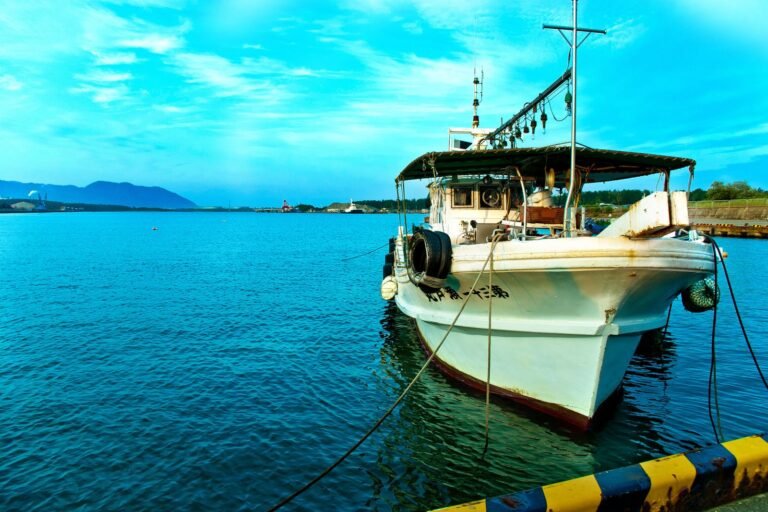
Check the hull. In Osaka, registered boats show “釣大阪府” and a four-digit number, and carry a registration certificate on board. Wakayama boats carry a “Maru-tsuri” (マル釣) mark. Osaka and Hyogo both publish lists of registered operators you can check before you book.
We’d pick a boat that shows its number. If an operator doesn’t, ask before you pay. Hyogo’s list of registered operators (in Japanese) runs six pages.
Ports and seawalls
None of the five prefectures publishes a list of ports where fishing is banned. Signs and the port manager decide. Osaka is the exception, because Osaka City sets keep-out areas by ordinance.
Osaka City’s rules for Osaka Port (official page, in Japanese):
- Keep-out list: Breakwaters, seawalls and quays aren’t meant for the public. The list includes breakwaters and seawalls around Nanko (南港), Yumeshima (夢洲) and Maishima (舞洲)
- Open zones: Some areas are open to anglers. Wear a life jacket, don’t fish alone, check the ring buoys and rope ladders, and take your trash, hooks and line home. At ferry-access zones, follow the ferry operator
- Hours: Some open zones close on Wednesdays (except holidays) and from December 28 to January 4. They open 7:00–17:00, or 5:00–19:00 from April to November. The city’s map shows which zones, and we couldn’t tell from the text
The prefecture runs two ports with their own entry limits: Sakai-Senboku Port (堺泉北港) and Hannan Port (阪南港). At 15 zones where international ships dock, the limit covers the water in front of the quay too. The gate checks your ID, affiliation and purpose.
If you want to fish Osaka Port, we’d pick an open zone on the city’s map and bring a friend. The city requires anglers there not to fish alone.
⚠️ Set nets and buoys — Hooks left on set nets injure workers when they change the net (Kyoto). Wakayama asks you to stay away from set nets and gill nets
- Work areas — Fishing ports are places of work. Kyoto asks anglers not to block operations, and says short parking is free if it doesn’t hinder fishing boats
- Life jacket — Osaka and Hyogo both ask you to wear one
- Throwing — Wakayama asks you not to cast toward people or boats, and not to fish near port mouths or fairways from a rubber boat
Penalties
This table shows maximum penalties, not typical ones. Some prefecture pages still use older wording and old Fisheries Act article numbers. We give the amounts under the current Fisheries Act, checked on e-Gov.
| What you did | Maximum penalty |
|---|---|
| Broke a prefecture sea rule (closed season, size limit, banned area) | Up to six months in prison or a fine of up to ¥100,000, or both. Your catch, boat and gear can be confiscated |
| Used a method anglers can’t use | A minor fine (karyō, 科料) |
| Trolled as a foreign visitor outside the areas and periods the government lists | Up to three years in prison or a fine of up to ¥30,000,000, or both |
| Took a species covered by fishing rights (octopus, spiny lobster) | Fine of up to ¥1,000,000 under the Fisheries Act |
| Took abalone or sea cucumber | Up to three years in prison or a fine of up to ¥30,000,000 under the Fisheries Act |
| Took a Hyogo Seto Inland Sea red sea bream of 12 cm or less in July to September | Up to two years in prison or a fine of up to ¥500,000, or both |
| Ignored the governor’s order to obey a committee instruction (such as a chum ban) | Up to one year in prison or a fine of up to ¥500,000, or detention or a minor fine |
| Drove a recreational motorboat too close to divers or nets (Mie) | Fine of up to ¥50,000 |
Source: Osaka, Hyogo, Kyoto, Wakayama and Mie fisheries regulations, Hyogo Prefecture, Mie Prefecture and the Fisheries Act on e-Gov (in Japanese), checked October 2026. The trolling penalty is from the Act on Regulation of Fishing Operations by Foreign Nationals (Article 8-2), checked November 2026.
A committee instruction has no direct penalty. The penalty applies when you ignore the governor’s order to follow it.
Who to Ask (and English Support)
We couldn’t find an English contact for fishing rules in any of the five prefectures. We’d have a Japanese speaker or a translation app ready when you call.
- Osaka Prefecture, Fisheries Division: 06-6210-9613 / +81-6-6210-9613
- Osaka Port breakwaters (Osaka City Port Bureau): 06-6571-1745 / +81-6-6571-1745. For seawalls: 06-6572-2691 / +81-6-6572-2691
- Hyogo Prefecture, Fisheries and Ports Division: 078-341-7711 / +81-78-341-7711
- Kyoto Prefecture, Fisheries Division: 075-414-4994 / +81-75-414-4994
- Wakayama Prefecture, Resource Management Division: 073-441-3010 / +81-73-441-3010
- Mie Prefecture, Fisheries Administration: 059-224-2588 / +81-59-224-2588
- Sea emergency: 118
For general help in English, Wakayama’s international center takes consultations in English, 10:00–16:00 by reservation: 073-435-5240 / +81-73-435-5240. We couldn’t confirm that it answers fishing-rule questions.
To call from your phone, you’ll need data or a Japanese SIM. Our eSIM guide for fishing in Japan has options.
FAQ
QDo I need a fishing license in Kansai?
No, not for rod fishing in the sea. Our license guide explains more.
QCan I fish for octopus in Osaka?
Not in the fishing-rights waters from Izumisano south, where octopus fishing can be punished. Fishing parks there set their own rules, so check the park’s guide. For waters north of there, we couldn’t confirm an octopus rule, so call the Osaka fisheries division first.
QCan I fish for octopus in Akashi?
Yes, in winter. Fish from December 1 to March 31, between 5:00 and 12:00, with at most 10 octopus per person.
QCan I take abalone or sea cucumber?
No. All five prefectures ban it, and Hyogo says to put it back if you hook one.
QCan I keep small fish?
It depends. The legal limits are few: octopus of 100 g or less and bora in Hyogo, bora in Osaka, and spiny lobster in Wakayama and Mie. Most other size limits are requests.
QCan I chum from a boat?
Not in Hyogo. In Wakayama and Mie, only the listed waters are off-limits, so ask your boat operator.
QWhat happens if I break a rule?
Most rule breaks carry up to six months in prison or a ¥100,000 fine. Taking a fishing-rights species can bring a fine of up to ¥1,000,000.
QDo I need to register to fish for bluefin tuna?
Yes, for large fish. Kyoto and Mie say you notify the Fisheries Agency ahead of time. Ask your boat who files.
Ready to Book?
Know the rules first, and the only thing that should slip off your hook is a small fish.
If you’re staying in Osaka, Kyoto or Kobe and want a day on the water, these three checks cover most of the trouble.
Check the prefecture
Match your spot to Osaka, Hyogo, Kyoto, Wakayama or Mie before you read its rules.
Ask before you keep octopus
Akashi in winter is the clear exception.
Check the boat
Ask for its registration number and look for it on the hull.
Looking for a place to start? These Kansai guides cover specific spots and trips:
- Osaka Bay private fishing charter
- Osaka Bay fishing guide
- Nanko Fishing Park, Osaka
- Totto Park Koshima, Osaka
- Amagasaki Fishing Park
- Wakayama Marina City fishing park