Last checked: October 11, 2026
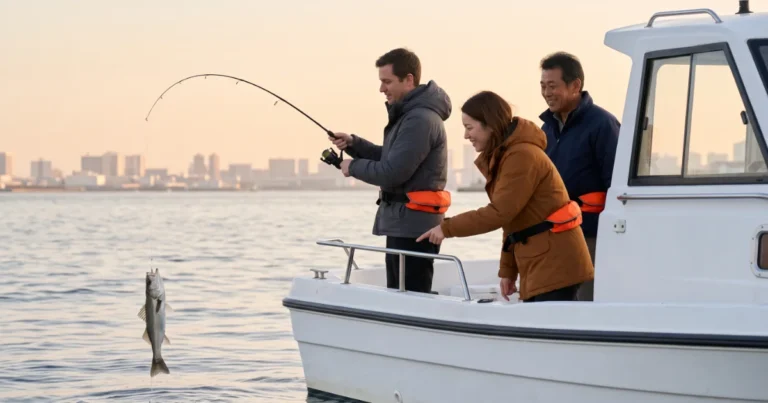
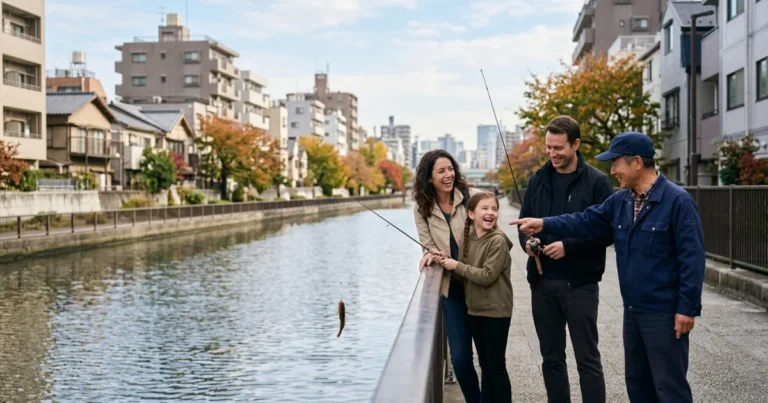
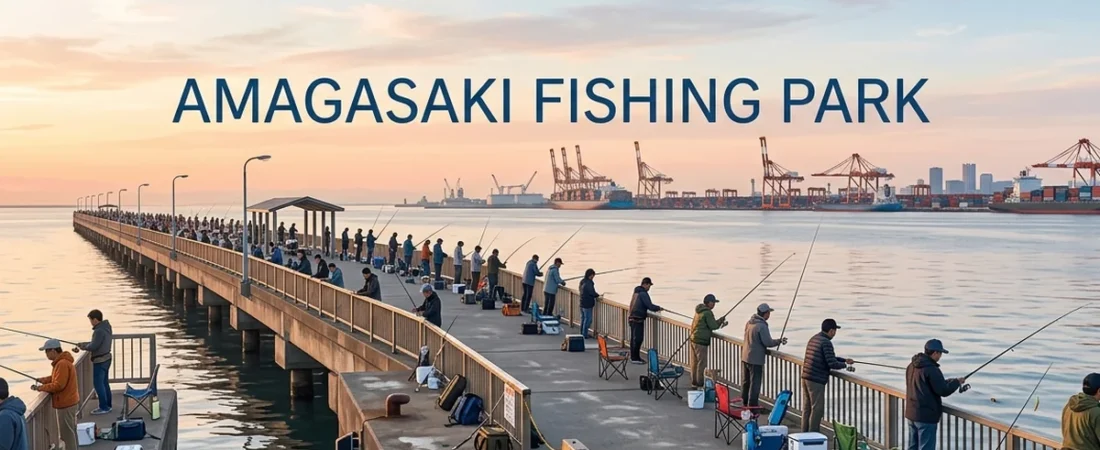
Amagasaki City Fishing Park is a city-run fishing pier at the mouth of the Mukogawa River, in Amagasaki between Osaka and Kobe. It opened in 1982. It rents rods, and its staff instructors give fishing tips. If you want to try pier fishing in Japan without a boat, you can reach it from Osaka on the Hanshin Line.
We built this guide from the park’s official site, its daily catch reports and Hanshin’s station pages. We flag anything we couldn’t confirm.
KANSAI REGION
Amagasaki City Fishing Park, Hyogo
Getting there: Hanshin Mukogawa Station, then the park's shuttle car (you phone for it) or a taxi
At a Glance
- Entry: adults ¥830, children 6 to 15 ¥410, under 6 free. Rental rod with tackle ¥1,500 (as of October 2026)
- Hours: 7:00–17:00 from December to April, up to 5:00–20:00 from July to October
- Closed: Tuesdays (if a Tuesday is a holiday, the park opens and closes on Wednesday), December 31 to January 1, and bad-weather days
- Getting there: Hanshin Mukogawa Station, then the park’s shuttle car (you phone for it) or a taxi
- Kids: grade 3 and under must wear a life jacket, lent free
- Bring: cash and a translation app. The official site lists no card brands and no English support
Prices, plans and available dates vary. Check the booking page before you book.
Is Amagasaki City Fishing Park Right for You?
✅ Great if you…
- have no gear. Rental rods come with or without tackle
- want help. Staff are based in the management building, and instructors give fishing tips
- are fishing with young kids. Kids’ life jackets are free to borrow
- want a winter target. Sea bass and black sea bream on live shrimp peak from December to April
⚠️ Think twice if you…
- want to walk from the station. It is about 4.2 km, so you need the shuttle, a taxi or a car
- can’t make a phone call in Japan. The shuttle comes only after you call
- want to fish with lures. Lure fishing isn’t allowed
- plan to arrive late on a Sunday. The park may limit entry when it is full
Quick Facts
- Name: Amagasaki City Fishing Park (尼崎市立魚つり公園, Amagasaki-shiritsu Uotsuri Kōen)
- Address: 66 Heizaemon-chō, Amagasaki, Hyogo 660-0087
- Nearest station: Hanshin Mukogawa Station, about 4.2 km away
- Opened: 1982
- Layout: a walkway of about 120 m from the river mouth, then a fishing pier about 200 m long and 8 m wide running east and west. The park says it holds about 300 anglers
- Reservations: the official site describes no booking system for entry
- Phone: 06-6417-3000. Use it on the day, for example to call the shuttle
Why Anglers Like This Park
The park is built like one long pier. A 120 m walkway leads out from the river mouth to the fishing pier, which is 8 m wide and about 200 m long. With room for about 300 people, beginners and regulars fish side by side. On busy days the park may limit entry (more on that below).
Most of what a first-timer needs is on site. The management building has staff, instructors, chairs, a hand-washing area, a free tea dispenser, a shop with tackle, bait and ice, a microwave and a cup-noodle vending machine. The park says you can eat a packed lunch on the benches or at the tables. Rental rods are available, and children in grade 3 and under can borrow a life jacket for free.
You can also scout before you leave home. The official site publishes a yearly catch calendar, daily catch reports and a live camera, so you can see what has been biting lately. Catches are never guaranteed. Sea bass and black sea bream are on the calendar for all 12 months. The park’s reports describe two seasons: sabiki for small schooling fish from May to November, and live-shrimp chum fishing from December to April.
How to Get There
By Hanshin Train and Shuttle Car
From Osaka, take the Hanshin Main Line to Mukogawa Station. The park’s access page says to walk seaward along the river road and go down the stairs at the end. Board the car marked “Mukogawa Watashi” (武庫川渡船). It leaves from the bus rotary under National Route 43. The car is mainly for anglers, and it only comes after you phone the park.

Wait, I have to call a Japanese phone number just to get a ride from the station?

Yes. The park’s notice says the shuttle runs only after you phone, so keep the number handy.
The park’s August 2026 notice gives these times:
6:15
First pick-up at the station
There is no car in the 5:00 hour
:15 past each hour
Pick-ups after that, every hour
On the hour
Drop-offs back to the station
19:00
Last pick-up from July to October
Call 06-6417-3000 when you reach the pick-up point. Save the number in your phone before you leave. A local eSIM such as Saily keeps the call and your map working.
Walking is possible on paper but not practical. Google Maps shows about 4.2 km and 56 minutes.
By Taxi
The park’s access page says a taxi from the station is convenient. Google Maps shows about 7 minutes by car (route on Google Maps).
By Rental Car from Kansai Airport
If you land at Kansai International Airport (KIX), you can look for rental cars on the EconomyBookings KIX page. Prices and available cars vary by date.
Google Maps shows about 41 minutes and 52.4 km from the airport in normal traffic, with toll sections. Here is the route on Google Maps. The park’s access page says to leave the Hanshin Expressway Route 5 (Wangan Line) at the Amagasaki-Suehiro exit and turn left at the first traffic light. Parking is charged by time. The cap is ¥800 for 8 hours or more (as of October 2026).
Cars drive on the left in Japan. According to JAF, you need an International Driving Permit issued under the 1949 Geneva Convention, and permits under other treaties aren’t valid. Police may ask for your passport, so carry it. Rules differ by country, so check JAF’s page before you go.
Hanshin Passes
If you plan to ride the Hanshin Line more than once in a day, for example to add Koshien after fishing, a pass is worth a look. You can see the KKday Hanshin 1-day pass, or the Klook Hanshin 24-hour pass with Koshien Historical Museum. According to its booking page, the Klook pass is not available to Japanese passport holders, and you pick it up at the Hankyu Tourist Information office in Umeda.
Neither pass includes the fishing park’s entry fee.
Luggage and Lifts
Mukogawa Station has elevators, so wheeling a bag between the platform and the gate is manageable. Hanshin’s station guide lists lockers at the station.
I’m coming straight from my Osaka hotel with a suitcase. Will it fit in a locker at Mukogawa Station?
Hanshin doesn’t list locker sizes, so we can’t promise it will. For a big bag, leaving it in central Osaka is safer.
If you need a place to leave a large bag before you head out, Radical Storage lists luggage storage in central Osaka. At the park itself, the official guide lists coin lockers at ¥100 per use (as of October 2026).
Hours, Closed Days and Crowds
Opening hours change with the month, according to the park’s official guide.
| Months | Hours |
|---|---|
| December to April | 7:00–17:00 |
| May, June and November | 6:00–19:00 |
| July to October | 5:00–20:00 |
Source: Amagasaki City Fishing Park official guide, checked October 2026.
The park is closed on Tuesdays. If a Tuesday is a national holiday, the park opens and closes the next day, Wednesday, instead. It is also closed on December 31 and January 1, and on bad-weather days. Strong wind or high waves can close the pier at short notice. In that case, the park says entry tickets used within four hours of entering, and viewing tickets, can be reused on a later day. Keep your ticket until you leave.
On busy days, especially Sundays, the park may limit entry once it is crowded.
So if I turn up at noon on a Sunday, could they really turn me away at the gate?
It can happen when the park is full, so an early start is safer.
The park’s own catch reports show how it plays out. Reports for May 17, June 14, August 16 and October 4, 2026, all Sundays, mention an entry limit being lifted later in the day. On May 17 it was lifted at 13:00, and on October 4 at 10:00.
⚠️ Opening time vs the first shuttle — From July to October the park opens at 5:00, but the first shuttle car is at 6:15. If you rely on the shuttle, you won’t be there at opening time
Prices, Rentals and What to Bring
These are the park’s official prices (as of October 2026):
| Item | Price |
|---|---|
| Fishing entry, adult | ¥830 |
| Fishing entry, child (6 to 15) | ¥410 |
| Children under 6 | Free |
| Viewing only (no fishing), adult / child | ¥200 / ¥100 |
| Rental rod with tackle | ¥1,500 |
| Rental rod without tackle | ¥1,300 |
| Coin locker (per use) | ¥100 |
| Parking | Charged by time, ¥800 cap for 8 hours or more |
Source: Amagasaki City Fishing Park official guide and access page, checked October 2026.
A rental rod with tackle is the simplest start if you have no gear. Bait, tackle and ice are sold at the park shop. The park’s notices sometimes say live shrimp (shirasa-ebi) has sold out, so arrive early if you plan to fish with it.
Payment methods are not listed on the official site, and the site itself is in Japanese.
Can I just tap my card at the gate, and will anyone there speak English?
The official site lists neither card brands nor English support, so bring cash and a translation app.
Carry enough yen for the entry fee, a rental rod, a locker, bait and parking. If you need help, point at the item in the price table or show its Japanese name on your phone. Bring sun protection and water too. Several catch reports warn about heat in May and July.
Rules and Safety
Children get the most specific rules here.
⚠️ Life jackets — Children in grade 3 and under must wear one. The park lends them for free. The official guide sets no life jacket rule for adults
- Children and adults — Children aged 10 and under need an adult with them. Children under 16 need an adult after 18:00
- Methods — Only rod fishing and hand-line fishing. Dangerous casting and lure fishing aren’t allowed
- Number of rods — The park may limit how many rods you use, so ask the staff
Mandatory? Does that mean I have to bring a life jacket for my kid myself?
No. The park lends life jackets free of charge to children in grade 3 and under.
The official guide also bans pets, being drunk, climbing or sitting on the railings, running on the pier, stoves and other open flames, and taking up more space than you need. Follow the staff’s instructions. The park can ask you to leave if you don’t.
Heat is the other everyday risk. The park’s catch reports carry heat warnings in May and July. Bring plenty of water and take breaks.
These are the park’s own rules. For fishing rules in Japan beyond the park, see our guide: do you need a fishing license in Japan?
What You Can Catch, Month by Month
The park posts a catch report almost every day, listing each fish and the method that caught it. We went through a year of those reports, from November 2025 to mid-October 2026. Under each season, the first group showed up on at least half of the report days. “Also reported” fish showed up on two or more days. Catches change from year to year, so read this as what anglers caught, not a forecast.
January – March
- Sea bass (suzuki, hane, seigo)ebi-makifloat fishingzubo
- Black sea bream (chinu)ebi-makifloat fishing
Also reported
- Mackerel, gizzard shad (konoshiro), sappa, horse mackerel, yellowtailmethod not reported
April
- Sea bassfloat fishingebi-makizubo
- Black sea breamfloat fishingzubofukase
- Mackerelsabiki
Also reported
- Anchovies and sardinessabiki
- Gizzard shad, horse mackerel, sappamethod not reported
May – June
- Anchovies and sardines, sappa, horse mackerel, gizzard shadsabiki
- Black sea breamfloat fishingfukaseotoshikomi
Also reported
- Sea bassfloat fishingebi-makizubo
- Mackerelsabiki
- Yellowfin seabream (kibire)fukasefloat fishingzubo
July – August
- Horse mackerel, sappa, mackerel, anchovies and sardines, gizzard shadsabiki
- Black sea breamfukaseKishu-zurifloat fishing
Also reported
- Sea bassfloat fishingnomasezubo
- Halfbeak (sayori), from Augustrendama-uki
- Yellowfin seabreamfloat fishingKishu-zurifukase
September – October
- Horse mackerel, sappa, mackerel, anchovies and sardinessabiki
- Halfbeak (sayori)rendama-uki
- Black sea breamnomaseKishu-zurifloat fishing
Also reported
- Gizzard shadsabiki
- Sea bassfloat fishingnomase
- Grouper (akou)float fishingsabikinomase
- Yellowfin seabreamnomase
November – December
- Sappa, mackerel, horse mackerel, anchovies and sardines, gizzard shadsabiki
- Black sea breamebi-makifloat fishingzubo
- Sea bassebi-makifloat fishingzubo
- Halfbeak (sayori)rendama-uki
Also reported
- Yellowtailnomase
- Grouper (akou)zubonomasesabiki
- Bigfin reef squid (aori-ika)ebi-maki
- Yellowfin seabream, scorpionfish (gashira), young Spanish mackerel (sagoshi), goby (haze), largescale blackfish (gure)method not reported
The methods in plain words
- sabiki — a rig of many small hooks, lowered into a cloud of chum for small schooling fish
- ebi-maki — live shrimp (shirasa-ebi) used both as chum and as bait on a float rig
- float fishing — bait hung under a float
- fukase — chum scattered to draw fish in, with a float rig drifting in the chum
- Kishu-zuri — bait packed inside a ball of groundbait
- nomase — a small live fish, such as a horse mackerel you caught on sabiki, used as bait for bigger fish
- zubo fishing — several short rods set along the pier edge, each fishing a different depth
- rendama-uki — a halfbeak rig with a row of small floats, fished near the surface
- otoshikomi — bait dropped slowly down right beside the pier wall
Source: Amagasaki City Fishing Park daily catch reports, November 2025 to October 2026, checked October 2026. Method descriptions: TSURI HACK and PROX.
A few fish are on the calendar but rarely in recent reports:
- Cutlassfish (tachiuo) — The calendar marks September to November. The park’s 2020 reports describe evening float fishing for them, and recent reports rarely mention them. Treat them as a bonus, not a target
- Japanese flying squid (surume-ika) — The calendar marks June to August, but in May 2024 the park wrote that squid have become much scarcer
- Flounder and greenling (karei, ainame) — The calendar marks December to February. In 2021 the park noted that worm bait dropped to the bottom at your feet sometimes catches 30 to 40 cm fish, though not many a year
- Surfperch (umitanago) — The calendar marks March to May. An official May 2025 report lists one 20 cm fish. We couldn’t find how it was caught
- Filefish (umazura-hagi) — The calendar marks December to February. A December 2024 report lists one 35 cm fish on sabiki
How Anglers Fish Here
Sabiki is where most visitors start, from May to November. You lower a rig of small hooks into a cloud of chum. The park notes that larger hooks, size 6 or above, are safer when big mackerel arrive, and that you need to keep putting chum out. Sabiki catches whatever swims by, and that includes small fish with venomous spines.
Venomous fish on a beginner’s sabiki rig? How would I know which one it is?
Treat any small fish you don’t recognize carefully. Don’t touch it with bare hands, and ask the staff if you’re unsure.
⚠️ Rabbitfish (aigo, アイゴ) — The park’s autumn 2026 reports say small rabbitfish have turned up on sabiki rigs. They ask anglers not to touch them with bare hands and say staff have been stung too
Ebi-maki is the local specialty from December to April. You scatter live shrimp near your hook to draw in sea bass and black sea bream. The park’s reports give the depth as roughly 3 to 5 hiro (a hiro is about 1.5 m). The shop sells the shrimp, but it sometimes sells out. In May the park says the season closes for the year.
Float fishing for sayori uses a line of linked floats. The park’s reports show 16 to 32 cm fish in September, then slower days in October and November. Black sea bream are on the calendar for all 12 months and are fished with float rigs, kishu-style rigs and live bait. In October, the park’s report says small fish caught on sabiki and used as live bait work well when bait stealers are thick.
Park Events
Dates are announced each year, so the months below are usual, not fixed, according to the park’s events page:
- Black sea bream derby — usually March and April
- Ladies’ fishing tournament — usually June
- Kids’ summer sabiki tournament — usually July
- Opening anniversary tournament — usually October
- Sayorinpic (halfbeak event) — usually October and November. In 2026 it runs from October 19 to November 15. Joining is free, but you pay the entry fee, and your fish are weighed when you leave
- Ebi-maki lesson for beginners — usually December, by reservation
- First fishing of the year — usually January 2
Where to Eat and Rest
Inside the park, the management building has a microwave, a cup-noodle vending machine and a free tea dispenser. The park says you can bring your own lunch and eat it on the benches or at the tables. We couldn’t find restaurants right next to the park on Google Maps. Around Mukogawa Station, the map shows izakaya, set-meal restaurants and kushikatsu places, so a meal before or after fishing is easier there.
A One-Day Plan
Build the day around the shuttle. Reach the bus rotary in time for the 6:15 car, fish through the morning and eat lunch in the management building. Then ride back to the station (drop-offs run on the hour) and take the Hanshin Line to Koshien. From December to April the park closes at 17:00, so check the time before you plan a long afternoon.
The Koshien Historical Museum is included in the Klook Hanshin 24-hour pass listing. As of October 2026, it is open from 10:00 to 18:00, with last entry 30 minutes before closing. It is closed on Mondays, except game days and holidays. It also closes from December 28, 2026 to January 3, 2027, and for maintenance from February 15 to 22, 2027. Check the Koshien Historical Museum’s site before you go.
FAQ
QDo I need to reserve?
No. The official site describes no booking system for entry. The shuttle needs a phone call on the day.
QIs English spoken?
Don’t count on it. The official site doesn’t mention English support, so bring a translation app.
QWhat if it rains or the wind is strong?
The park can close the pier in strong wind or high waves. Check the park’s latest notices on the day. If it closes within four hours of your entry, your ticket can be reused later.
QCan children fish?
Yes. Children aged 10 and under need an adult, children under 16 need an adult after 18:00, and life jackets are required for grade 3 and under.
QCan I bring my own rod?
Yes, for rod fishing. Lures aren’t allowed, and the park may limit how many rods you use, so ask the staff.
QIs the park open on a Tuesday holiday?
Yes. When a Tuesday is a national holiday, the park opens and closes on Wednesday instead.
Ready to Go?
Settle how you will get from the station to the park first, then add the rest of the day. If you are staying in Osaka or Kobe, start with the pass. If you are landing at the airport, start with the car.