Last checked: October 12, 2026
Picture a cold Hokkaido lake at dawn, rod in hand, and no idea whether you may keep what you catch. This guide is for that moment.
You can fish from the sea shore in Hokkaido without a license. But the prefecture’s rules are detailed, and some are easy to break by accident. Keeping a salmon from a river is one. Picking up sea urchins on a beach is another.
We built this guide from two sources. One is the Hokkaido Government’s Fishing Rules 2026 booklet (in Japanese). The other is the text of the Hokkaido Fisheries Adjustment Regulations (in Japanese). We say so when we couldn’t confirm something. The booklet is Japanese only, and rules change, so check with the Hokkaido Government or the local fisheries co-op before you fish.
At a Glance
- Sea fishing with a rod: no license needed
- Salmon in rivers and lakes: six kinds (chum, pink, sockeye, coho, chinook and masu) are banned all year. Releasing the fish doesn’t help
- Sea gear: only a rod, a handline, a small landing net or your bare hands
- On the shore: don’t take shellfish, sea urchins, octopus or seaweed
- Some lakes sell day tickets: ¥500–¥2,500 at the lakes in our table (as of October 2026)
Prices and available dates vary. Check the booking page before you book.
Who This Guide Is For
- You plan to fish a lake or river on your own
- You plan to fish from a harbor or rocky shore
- You plan to book a boat. A guided tour is different: ask the operator which rules apply to your trip
Do You Need a Fishing License in Hokkaido?
For rod fishing in the sea, no. We found no license system for it in Japan, and the Fisheries Agency’s page for foreign visitors says to follow local rules. Our guide to fishing licenses in Japan has the full picture.
Lakes and rivers work differently. Where a local fisheries co-op (gyokyō, 漁協) holds the fishing rights, you need its permit, called a yūgyoken (遊漁券). This day ticket is the closest thing to a license you’ll buy. The lake table below lists prices.
For boats, the rule is about the boat. A for-hire fishing boat in Hokkaido must be registered with the governor. More on that in the boat section.

So I don’t need any license at all?

For rod fishing in the sea, no. At some lakes and rivers you need a one-day ticket from the local fisheries co-op.
The Rules That Catch Visitors Out
Five rules cause most of the trouble. They’re all in the Hokkaido booklet.
Salmon and masu are off-limits in rivers and lakes, all year
You can’t catch salmon in any river or lake in Hokkaido, in any month. The ban covers chum salmon and five masu species: pink, sockeye, coho and chinook salmon, plus masu salmon. Rainbow trout isn’t on the list.
Releasing the fish doesn’t help. The booklet says fishing for a banned species counts as catching it. If you release it, it’s still illegal and can bring a penalty.
There’s one exception. In some rivers, a “utilization survey” lets registered people fish for salmon. The booklet names the Churui River (忠類川) and the Hamamasu River (浜益川). You must sign up in advance. The booklet said the 2026 plan would be decided around July, so ask the contacts in the booklet.
Kokanee (himemasu), the lake form of sockeye, is named separately in the regulation, and several lakes sell day tickets for it. Follow each lake’s season and rules. The exception is Lake Mashu (摩周湖): the regulation bans catching rainbow trout and kokanee there all year.
What if I let it go right away?
It’s still a violation. The booklet says fishing for a banned species counts as catching it, even if you release it.
In the sea: rod, handline, small net and bare hands only
In the sea, you may use a rod, a handline, a landing net with an opening under 40 cm, or your bare hands. Nothing else.
Trolling and towed-line fishing are banned. So is snagging, where you hook a fish by dragging a hook through the water. The booklet says snagging doesn’t count as rod fishing.
Rivers and lakes have their own list of banned methods: electric shock, spears, gaffs and snagging hooks, and certain nets.
Leave shellfish, sea urchins, octopus and seaweed alone
Local fishing co-ops hold the rights to many sea animals and plants. Taking them can lead to a fishing-rights charge or even theft. The booklet’s examples include:
- Seaweed, such as kelp
- Sea urchins (uni)
- Octopus
- Mantis shrimp (shako)
- Clams, scallops and oysters
Octopus fishing is illegal in areas where octopus is part of the local fishing rights. Baskets, rakes, crab nets and scuba tanks are also banned for taking these animals.
Abalone, sea cucumbers and glass eels are banned in all waters.
There are sea urchins right by the rocks. Can I take a few?
No. They belong to the local fishing rights, and taking them can bring a criminal charge.
Some lakes and rivers need a day ticket
Several famous lakes sell day tickets, each with its own season and price. The lake ticket table below covers six lakes.
Don’t move fish, and don’t release invasive fish
Don’t release brown trout, brook trout (kawamasu) or snakehead (kamuruchi) into new waters. Moving them is banned, with a penalty of up to six months in prison or a fine of up to ¥100,000.
Don’t put a carp you’ve caught back into another river, lake or pond. The reason is a carp virus.
Black bass, bluegill and several other invasive species are covered by a national law. The booklet asks anglers to kill them and take them home rather than throw them back. Keeping, moving or releasing them without permission is illegal.
River and Lake Seasons by Area
Yamame (yamabe) season depends on where you are
Yamame (called yamabe in Hokkaido) are small masu salmon that stay in streams. The ban dates depend on the area. Hokkaido is split into 14 subprefectures, and the dates below follow that split.
This table shows when yamame fishing is banned in rivers and lakes near towns visitors go to.
| Yamame fishing banned | Towns |
|---|---|
| April 1 to May 31 | Sapporo, Chitose (Lake Shikotsu), Otaru, Niseko, Kutchan, Yoichi, Hakodate, Nanae (Lake Onuma), Toyako and Sōbetsu (Lake Toya), Noboribetsu, Shiraoi (Lake Kuttara), Asahikawa, Furano, Biei, Horokanai (Lake Shumarinai) |
| May 1 to June 30 | Kushiro, Lake Akan (Kushiro city), Teshikaga, Obihiro, Kamishihoro (Lake Nukabira), Abashiri, Shari (Utoro), Rausu, Nemuro, Wakkanai, Erimo |
Source: Hokkaido Government, Fishing Rules 2026, and the Hokkaido list of municipalities by subprefecture, checked October 2026.
If you visit in June and want yamame, we’d suggest basing your trip around Sapporo, Hakodate, Asahikawa or Furano. The yamame ban there ends on May 31. Around Kushiro, Obihiro, Shiretoko and Wakkanai, it runs to June 30.
Two exceptions. Rivers flowing into Lake Shumarinai (朱鞠内湖) and Lake Nukabira (糠平湖) are banned for yamame all year. The regulation sets no size limit for yamame.
We read the rule this way: the regulation defines yamabe as masu salmon that stay in fresh water after hatching. The big sea-run adults fall under the all-year masu ban. If you hook a large masu in a river, treat it as banned and ask before you keep it.
Planning Furano? The booklet’s map shows no special rule marks around Furano, Nakafurano, Kamifurano or Minamifurano. The yamame ban still applies through May 31.
Ayu
Fishing for ayu (sweetfish) is banned in all rivers and lakes from April 1 to June 30, and again from September 16 to October 31.
Protected waters and river-mouth zones
Some waters are protected. In “protected waters,” all aquatic animals are banned all year. In “resource protection waters,” only listed species are banned, for set periods. Yamame, for example, can be banned from June 1 to March 31 there.
River mouths where salmon are stocked have banned zones in the sea. They’re marked by posts. We couldn’t confirm what the signs say. For example, the Ishikari River’s zone was 1,000 m to each side of the mouth and 2,000 m offshore, from May 1 to November 30 (2025 season).
Zone details differ by river and change by year. The booklet’s area maps (in Japanese) show them, and the booklet said the 2026 orders would be posted on the Hokkaido site around August. Call the subprefecture before you fish near a river mouth.
Private fish in some lakes
Some lakes have fish that belong to a rights holder. These are Lake Utonai (ウトナイ湖), Mikazuki-numa (三ヶ月沼) and Lake Shikaribetsu (然別湖). Taking farmed fish can count as theft. Some rights holders allow fishing, so ask each one. Part of Lake Shikaribetsu bans catching any aquatic animal all year.
Lake Day Tickets
This table shows the day ticket price and season at six lakes, as listed in the 2026 booklet. Prices include tax.
| Lake (nearest town) | Season | Day ticket |
|---|---|---|
| Lake Shikotsu (支笏湖, Chitose) | Kokanee (himemasu): June 1 to August 31 | Shore ¥750 / boat ¥1,500 |
| Lake Toya (洞爺湖, Toyako and Sōbetsu) | Shore: June to August, December to March. Boat: June, December to March | Shore ¥1,200 / boat ¥1,500 |
| Lake Kuttara (倶多楽湖, Shiraoi) | Kokanee (himemasu): May 15 to July 31 | ¥1,500 |
| Lake Akan (阿寒湖, Kushiro city) | May 1 to November 30 | ¥1,500 (¥2,000 with a boat you bring) |
| Lake Akan, winter | January 1 to March 31 | ¥1,100 |
| Lake Shumarinai (朱鞠内湖, Horokanai) | Itou (Japanese huchen) and whitespotted char: May 1 to December 10 | Lure or fly ¥1,500 / bait ¥2,500 |
| Lake Shumarinai, winter | January 10 to April 10 | ¥1,300 |
| Lake Onuma (大沼, Nanae) | Japanese smelt: all year. Koi and funa: March 1 to December 20 | Smelt ¥800 / koi and funa ¥500 |
Source: Hokkaido Government, Fishing Rules 2026 (Lake Akan also checked on the official Kushiro Lake Akan site), checked October 2026.
The booklet says fees can rise or fall under each co-op’s own rules. Treat these as a guide and confirm with the co-op.
A few more details from the booklet:
- Lake Shikotsu hours: June 3:00–19:30, July 3:30–19:30, August 4:00–19:00
- Lake Toya hours: 4:00–19:00
- Lake Akan hours: one hour before sunrise to one hour after sunset in May–November. Sunrise to sunset in winter
- Lake Akan gear: up to two rods, one hook per rod, except for smelt and a few other fish. The Akan River allows one rod and one hook. A stretch of the river below the lake outlet is catch-and-release only
If you want to try kokanee, we’d pick Lake Shikotsu. Its shore ticket, ¥750, is the lowest kokanee ticket in the table, and fishing starts at 3:00 in June.
Each lake’s season, fish and ticket differ, so match your dates to the table before you book a trip.
Where to buy the ticket
You buy day tickets from the local fisheries co-op. We couldn’t confirm where each co-op sells them, or whether they take cards or cash. We also couldn’t confirm any English support. One travel article says you buy at the co-op’s management building at Lake Shumarinai.
We’d suggest calling the co-op before driving to the lake. These are the numbers from the booklet:
- Lake Shikotsu: 0123-25-2059 / +81-123-25-2059
- Lake Toya: 0142-66-2312 / +81-142-66-2312
- Lake Kuttara (Shiraoi branch): 0144-83-4660 / +81-144-83-4660
- Lake Onuma: 0138-67-2329 / +81-138-67-2329
- Lake Akan: 0154-67-2750 / +81-154-67-2750
- Lake Shumarinai: 0165-38-2470 / +81-165-38-2470
Where do I buy the ticket?
At the local fisheries co-op. We couldn’t confirm the shop locations or hours, so call first. The numbers are above.
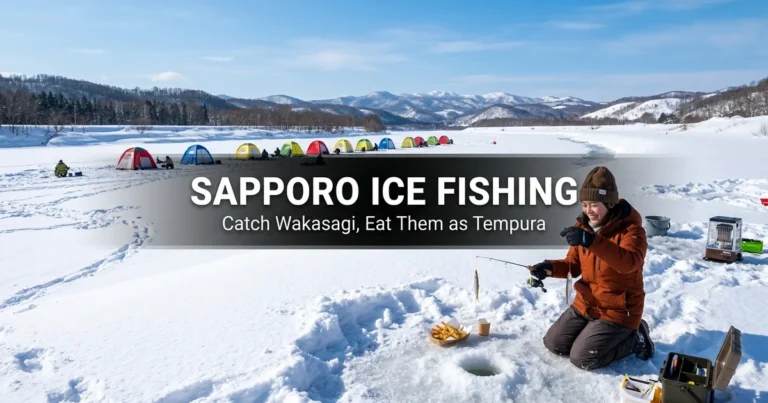
Want to try winter lake fishing? Our Sapporo ice fishing guide covers a Klook trip for Japanese smelt.
Sea Fishing Rules
Size limits and protected crabs
These size limits apply in the sea. The table shows the smallest size you may keep.
| Catch | Banned if |
|---|---|
| Chum salmon and the five masu species | Under 20 cm total length |
| Hokkigai (a surf clam) | Shell under 7.5 cm |
| Sea urchin, ezobafun-uni (gaze) | Shell under 4 cm |
| Sea urchin, kitamurasaki-uni (nona) | Shell under 5 cm |
| Hair crab (kegani), male | Shell under 8 cm |
| Hair crab (kegani), female | All females |
| Hanasaki crab (a king crab), male | Shell under 8 cm |
| Hanasaki crab (a king crab), female | All females |
Source: Hokkaido Fisheries Adjustment Regulations (Article 39), checked October 2026.
Clams and sea urchins also fall under local fishing rights. Even a legal size doesn’t make them yours to take. Leave them.
Barfin flounder on the Pacific coast
Barfin flounder (matsukawa) under 35 cm must be returned to the sea quickly. The rule covers the Pacific coast from part of Hakodate (古部町) east to the eastern end of Erimo.
Salmon fishing from the shore and river mouths
In the sea, you can fish for salmon outside river-mouth zones if the fish is 20 cm or longer. Zones are marked by posts, and each river has its own rule. See the river-mouth section above. Boat fishing has extra rules, below.
Abashiri, Shari and Koshimizu have local salmon rules. The booklet points to a QR code for them.
Salmon boats need a licensed boat
For some salmon fishing from a boat, you must board a boat with a license:
- Autumn salmon: off Shari, Abashiri and Utoro, early to late September
- Masu salmon: Iburi from December to March, Shiribeshi from March to May, Hiyama from January to May
If you want autumn salmon off Shari, Abashiri or Utoro, we’d book a licensed boat. The booklet says you must board one in those waters in September.
Pacific bluefin tuna: report before you fish
Anglers targeting large Pacific bluefin tuna (30 kg or more) must file a notice once a year. This rule started in April 2026. You can file on a website, by email or on paper. The booklet says to file by one business day before the first day you try to catch one.
If you catch one without filing, the minister can issue an order. Ignoring it can bring up to one year in prison or a fine of up to ¥500,000.
We couldn’t confirm whether a boat passenger files for themselves or whether the boat does it. We also couldn’t confirm whether the form needs a Japanese address or phone number. If you want to fish for bluefin, we’d suggest asking the boat before booking who files and what you need.
The Fisheries Agency has an English leaflet. Read it on the Fisheries Agency page (in Japanese, with an English leaflet). The agency’s phone number is 03-3502-8111 (extension 6705) / +81-3-3502-8111.
Fishing ports: where you can and can’t go
⚠️ Before you walk out on a fishing harbor
- Swimming-ban zones — Some fishing harbors ban swimming, and that includes wading in to fish
- Keep-out areas — The booklet’s list of places to stay out of includes kelp drying grounds, facilities with entry bans and breakwaters
- Parking — Don’t park in ways that bother nearby homes or the harbor
- Fines — Breaking the rules in these zones can bring a fine
For larger commercial and regional ports, ask the port manager. The booklet lists the contacts, but only in Japanese.
Booking a Fishing Boat in Hokkaido
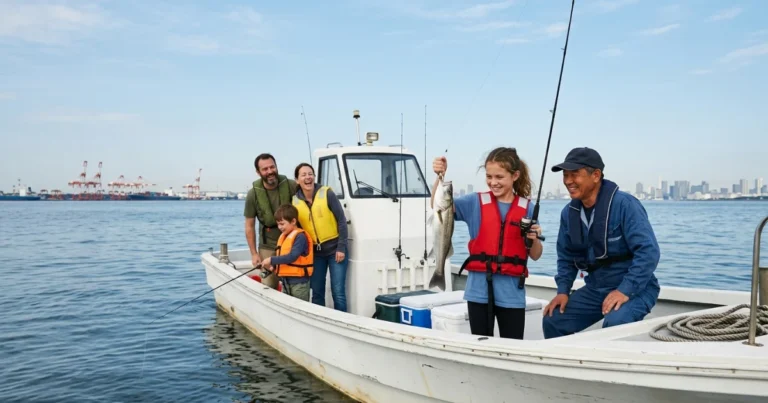
A legal fishing boat is registered with the Hokkaido governor. Both sides of the hull show “(登)北海道” followed by a four-digit number. The boat also posts a registration certificate on board.
The operator must carry insurance of at least ¥50 million per passenger seat. On board, follow the captain’s instructions and those of the boat’s operations manager.
Before you book, check that the operator lists a registration number. If it doesn’t, ask. We’d also recommend checking the number on the hull when you board. It’s the one rule you can verify with your own eyes.
If you rent a small boat that needs no license, the booklet’s guideline is simple. Stay within 2 km of the launch point and return before sunset. Don’t tie up to fishing gear offshore.
Penalties
Breaking Hokkaido’s fishing rules can bring up to six months in prison or a fine of up to ¥100,000. This table shows the maximum penalties, not typical ones.
| What you did | Penalty |
|---|---|
| Broke a Hokkaido fishing rule (size limits, closed seasons, protected waters, banned methods such as snagging in rivers, releasing brown trout) | Up to six months in prison or a fine of up to ¥100,000, or both. Your catch and gear can be confiscated |
| Violated fishing rights (such as taking sea urchins) | Fine of up to ¥1,000,000 |
| Took abalone, sea cucumbers or glass eels | Up to three years in prison or a fine of up to ¥30,000,000 |
| Kept, moved or released a designated invasive species without permission | Up to three years in prison or a fine of up to ¥3,000,000 |
| Ignored a minister’s order about bluefin tuna | Up to one year in prison or a fine of up to ¥500,000 |
Source: Hokkaido Fisheries Adjustment Regulations (Article 62) and the Fishing Rules 2026 booklet, checked October 2026.
The inland salmon ban sits under a separate law, the Fisheries Resources Protection Act. The booklet says a banned fish is illegal even if you release it, and that a penalty can follow.
Manners and Safety
- Poaching is a crime. Take your trash and your fish home
- Don’t park in ways that bother nearby homes or harbors
- Stay away from fishing gear that’s set out
- Stop fishing if a typhoon or tsunami is possible
- Release small fish
- Fold your rod before you walk under power lines, to avoid electric shock
- Wear a life jacket
- Don’t claim a spot with stakes or tents. The booklet says it can break the law or cause trouble
Who to Ask (and English Support)
Start with the Hokkaido Government’s Fisheries Management Division: 011-204-5485 / +81-11-204-5485. We couldn’t confirm any English support, so we’d have a Japanese speaker or a translation app ready.
You can also call the subprefecture office for the area you’ll fish. A subprefecture is a regional branch of the Hokkaido Government. These cover the main visitor areas:
- Ishikari (Sapporo, Chitose): 011-204-5842 / +81-11-204-5842
- Shiribeshi (Otaru, Niseko): 0136-23-1394 / +81-136-23-1394
- Oshima (Hakodate): 0138-47-9484 / +81-138-47-9484
- Iburi (Toyako, Noboribetsu, Shiraoi): 0143-24-9811 / +81-143-24-9811
- Kamikawa (Asahikawa, Furano): 0166-46-5959 / +81-166-46-5959
- Kushiro (Lake Akan, Teshikaga): 0154-43-9213 / +81-154-43-9213
- Okhotsk (Abashiri, Shari): 0152-41-0656 / +81-152-41-0656
To call from your phone, you’ll need data or a Japanese SIM. Our eSIM guide for fishing in Japan has options.
Show a phrase from this table when you meet someone at a lake or harbor:
| English | Japanese | How to say it |
|---|---|---|
| Where can I buy a fishing ticket? | 遊漁券はどこで買えますか? | Yūgyoken wa doko de kaemasu ka? |
| May I fish here? | ここで釣りをしてもいいですか? | Koko de tsuri o shite mo ii desu ka? |
| May I take this fish home? | この魚は持ち帰ってもいいですか? | Kono sakana wa mochikaette mo ii desu ka? |
FAQ
QDo I need a fishing license in Hokkaido?
No, not for rod fishing in the sea. Some lakes and rivers need a day ticket from the local co-op. Our license guide explains more.
QCan I catch salmon in Hokkaido?
Not in rivers or lakes. In the sea, yes, outside river-mouth zones and only if the fish is 20 cm or longer. Some boat fishing needs a licensed boat.
QIs rainbow trout banned like salmon?
No. The all-year ban covers chum salmon and five masu species, and rainbow trout isn’t one of them. Lake rules and tickets still apply.
QCan I catch and release salmon in a river?
No. The booklet says fishing for a banned species counts as catching it, even if you let it go.
QCan I collect sea urchins or shellfish at the beach?
No. They fall under local fishing rights, and taking them can bring a criminal charge.
QWhen can I fish for yamame?
It depends on the area. Banned dates are April 1 to May 31 around Sapporo, Hakodate, Asahikawa and Furano, and May 1 to June 30 around Kushiro, Obihiro, Shiretoko and Wakkanai. See the table above.
QCan I fish at Lake Shikotsu?
Yes, for kokanee from June 1 to August 31, with a day ticket (¥750 shore, ¥1,500 boat, as of October 2026).
QDo I need to register to fish for bluefin tuna?
Yes, if you target fish of 30 kg or more. You file once a year, and you should ask your boat how to file.
Ready to Book?
Check the rules first, and the only thing that gets away is the fish.
Before you go, check the three things the booklet cares about most: your area and dates, the lake ticket, and the boat’s registration. If you’d like a guide to handle the river side, the Furano trip is a guided option.
Check the area and the date
Match your town to the yamame table and your lake to the ticket table.
Call the co-op
Confirm the ticket, the price and where to buy it.
Check the boat
Look for “(登)北海道” and a four-digit number on the hull.
Landing at New Chitose Airport? You can book a pickup to Sapporo ahead of time.